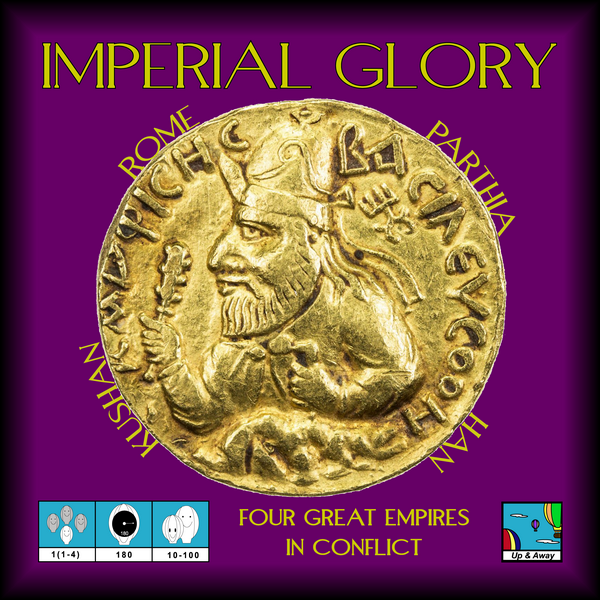
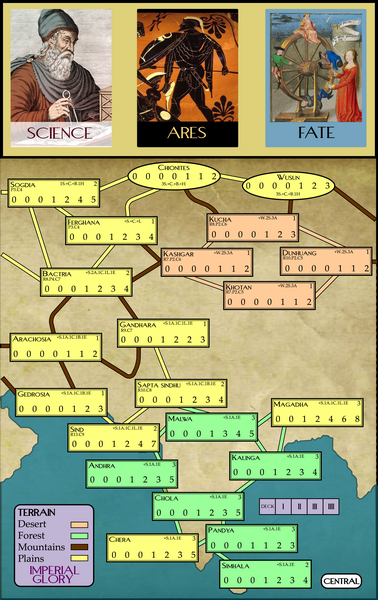
Manage an emperor ruling the Han or
Kushan empire. Features deckbuilding,
a push-your-luck action system and
unique battle board combat resolution.
In a new nation surrounded by
enemies and debt, you're the president.
Can you survive?
|
Manage an emperor ruling the Han or Kushan empire. Features deckbuilding, a push-your-luck action system and unique battle board combat resolution.
In a new nation surrounded by enemies and debt, you're the president. Can you survive? |
The "Britannia-style" games are listed in order of publication.
Following that is a list of
unpublished designs.
Contents
Introduction
Ancient Conquest
Biblical
R.J. Hlavnicka; Excalibre; 1975
Every phenomenon of any size must have its precursors; perhaps that's what
this game and the next are for the Britannia-style game.
Not area-, but
hex-based with counters that contain combat and movement points.
All of a player's nations are played
together and can even combine in defense, thought not in attack.
There is no
economic mechanism, so no new pieces are received as a result of
occupation, only scheduled reinforcements.
times.
Many of the point goals are for
taking cities. There is no stacking except in
cities. The only other way to score points is to destroy enemy
combat factors.
Ancient Conquest II
Britannia
Peninsula Italica
Maharaja
Hispania
Kampf um Rom
Chariot Lords
Vinci
Rus'
Kings & Castles
Dark Continent
Biblical with extensions to include Persians and Greeks through Alexander
R.J. Hlavnicka and Dennis P. O'Leary; Excalibre; 1978
British isles from the Romans to the Normans
Lew Pulsipher;
Gibson Games-1986?/Avalon Hill-1986/Welt der Spiele-1991; 3-5 (4 optimal)
Recent studies such as
Britain After Rome: The Fall and Rise, 400 to 1070 by Robin Fleming
tell us that the traditional model for the invasion of the Anglo-Saxons is
misleading at best. When the Romans left, there was no grand invasion of
mighty fleets. Instead, individuals from areas of less vibrant economy came
in incredibly small boats, some only big enough to hold one, up to a maximum
of about four and moved in. There they settled individually and tried to make
a go of it. Sometimes they discovered a Roman villa and explored it, but as
if in some post-apocalyptic dream, they did not know how to operate most of
what they found there and perhaps only grabbed a souvenir or two. In time
many kingdoms arose as those who knew how to seize power did so. There were
many more than the seven kingdoms named by Bede – names for at least
thirteen are known and there were no doubt many more – and their rulers
need not have been Germanic. Indeed, the names of some of the early dynasts
are Celtic. Later on, after much agglomeration of territory, kings sought
to legitimize their rules with legendary tales of their invasions, a fiction
that most still believe today.
Notes
Playback
Pre-Roman Italian peninsula
Camelot-1993
Available from
Strategia e Tattica
India from the Aryans to the British
Craig Sandercock; Avalon Hill-1994; 3-4
Pre-Gunpowder Variant
Spanish Peninsula from the Carthaginians to the Christian Reconquista
Andreas Steding; Azure Wish-1994; 4
Comparison with Britannia
Rome and invading barbarians
Gerhard Kuhlmann and Hartmut Witt;
Kuhlmann Geschichtsspiele-1995
This is actually two games in one.
Germanica is by Hartmut Witt and
Huns, Romans, and Germans by Gerhard H. Kuhlmann.
Both deal with the barbarian incursions into Rome.
Near East from the earliest history up until about 500 BCE.
Charles Vasey;
Clash of Arms-1999
Some differences from the Britannia rules include the
following:
initial setup is free and counter by counter;
order of nations within a turn is random;
redeployment phase;
mountains count as a double area for movement;
leaders do not add to the movement rate;
the basic movement rate is three;
leaders affect two areas in a round;
defender retreats first;
maximum number of rounds of combat is fixed (two or three);
growth is not based on number of areas owned;
units may return from the dead if for each a unit is removed permanently;
invaders need not double-stack to overrun;
submission rules are generalized;
submitted units are not allowed to move.
Prehistoric to Medieval Europe
Philippe Keyaerts;
Eurogames/Descartes Deutschland-1999; 2-6
Europe is divided into vague and unnamed territories of
different types: Agriculture I, Agriculture II, Forest, Mountain and miscellaneous.
Some territories also have a port or mining abilities.
Civilizations are represented by randomly drawn pairs of counters of various kinds: military,
resource, miscellaneous which are drafted by each player.
The player then takes a number of tokens based on the number of players and red numbers
on the counters which basically fixes the civilization size for its life.
Civilizations begin from an edge of the map and move into adjacent territories.
There are no dice. Conquest requires a number of tokens depending on the number of
defenders and variations caused by terrain and special abilities.
When after a few turns the civilization size has dwindled one usually
decides to let it "go into decline". This turn, it does not move by the player chooses a
new civilization. "Decline" counters are placed on the existing
territories leaving only one token each to still earn points.
And so on. Normally one plays two, three or four civilizations during the course of a game.
Russian early and medieval history
Randy Moorehead;
Simulations Workshop-2000; 4
1700 years of Russian history, from
the demise of the Scythians to the death of
Ivan the Terrible. Players lead Huns,
Goths, Mongols and other groups that
ravaged ancient and medieval Russia, as well
as the great city-states of Kiev, Novgorod,
and Moscow. Alexander Nevsky battles the
Teutonic Knights, the Mongols seek to destroy all in their path...
Medieval Britain
Gary Dicken, Phillip Kendall and Steve Kendall;
Ragnar Brothers-2000; 3-4
Game on England and her conquests for up to four by the inventors of
History of the World.
Sides are represented by individual kings and
entirely decided by draft before play even begins. Kings vary by the amount
of extra force they add and in their primary spheres of activity.
Play itself is diceless (and thus reminiscent of
Vinci),
the core of the combat system being a rather strange and unique form
of arithmetic. The active player's forces must defeat the inactive
defenders by the minimum possible amount – pieces are rated at value
1, 2 or 3 – but then only the strongest of these invaders remains.
The other unusual mechanism is that over the entire course only twenty-five
percent of one's forces are guaranteed to be one's own. The rest are drawn
from a bag and may be one's own, but are also often the forces of other
players, rebellious indigenous groups or mercenaries usable with any of the
above. (There are also three levels of fortification.) The need for a player
to clear out his force pool for the next set of forces means
often going through unusual gymnastics. For example, he may use other player
forces to conquer rebels, then use rebels to conquer them back and finally
use his own forces to conquer the rebels. The other unusual feature is
that in a four-player game, each player has only six turns and only on
half of them may he declare scoring (which occurs for all players).
Just as in their previous game, the board is no board at all, but printed on a folded cloth.
Nineteenth-century Africa
Peter Schutze and Lloyd Krassner;
Schutze Games;
2001; 2-4
Hegemonia
The Dragon and the Pearl
Britannia, second edition
Ancient Greeks
Sven Andressen; City-of-Games-2004; 3-5 (4 optimal)
From Agamemnon and Troy to the wars of Athens/Sparta and Persia, then Alexander the
Great and right up through Hannibal and the Roman conquest of the entire known world.
Simulating 1600 to 146 BCE in 16 rounds to last about 5 hours.
Includes 36 pages of rules, 60x60 cm board, 16 cards, 298 pieces, 5 dice,
scoring track, etc. Games are made on demand for 35 Euro + packing and shipping.
In German.
Ancient and Medieval China
Thom Richardson;
Spirit Games-2004; 4
Chinese history from 200-1300 (Han Dynasty to Mongols?).
Desktop-published game includes some 200 plastic counters in 4 colours with stickers,
color map on heavy paper and two pages of rules. Shipped in a roll without container.
Unlike Britannia, does not use special victory point awards for each particular group.
More at
Andrew Parkin's site
British isles from the Romans to the Normans
Lew Pulsipher;
Fantasy Flight Games-2005; 3-5 (4 optimal)
Combines together all the different versions of the rules and adds
a method for distributing nations that will provide greater variety in
the 3- and 5-player games (optionally also in the 4-player).
More at
Lew Pulsipher site
"Myths of British Ancestry" by Stephen Oppenheimer is a fascinating article on
the early peopling of Britain, mentioning for example that Germanic
languages were probably spoken there much earlier than previously thought
and also the Norwegian invasions of the isles prior to the Romans.
Obviously this game needs a prequel.
China: The Middle Kingdom
Small World
Reconquista!
Conquest Europa
Corsica
Duel Britannia
Invasions: Volume 1 – 350-650
Corsica
Roma aeterna
Chronicles of Japan
Mediterranea
Eurannia
Mandate of Heaven
Barbaria
Mesopotamia
Invasions
"History of the British Isles"TM (Mega-Brit)
Caledonia
Iberia
Albion
Byzantium
Hy Breasil
Italy
Italy
Romania
Empires in Ancient America
Frankia
Spotlight on Games
>
War Games
>
Ludographies
China: Warring States to modern
Tani Chen;
Decision Games-2008; 4
There are 400 army pieces,
are used in 24 game turns, each a century long, starting from 403 BCE.
Important aspects impinging on play are mountains, emperors, heroes,
new inventions, rebellions, barbarian invasions, diplomacy and the Great Wall.
Growth of each nation depends on the amount and nature of the territory it owns.
Fantasy
Philippe Keyaerts;
Days of Wonder/Edge Entertainment-2009; 2-5
Re-make of Vinci, now as a game of giants,
dwarves, elves, orcs, amazons and wizards.
Includes 14 races and 20 special powers.
The Struggle for Iberia, 850-1250 CE
Javier Romero; Decision Games-2013; 1-3
Includes
200+ counters representing Andalusians, North African yihadist forces (Almohades and Almoravides), Frankish, Catalan, Aragonese, Asturias/Leon, Castilians, Portuguese, Military Orders (Templars, Santiago, etc.) and Christian Crusaders.
Published in issue #279 of Strategy & Tactics magazine (January 2013).
Europe 400-1480
Roger Heyworth; (print and play)-2014; 6
The game includes 41 nations and covers from
the collapse of the Western Empire to Joan of Arc.
Playing time is about ten hours with rules
based on Britannia rules. Includes
two pages of special rules mainly for
enhanced movement and fighting;
submission and revolt;
sacking Rome;
"fight as they move" (to simulate the conquests of Attila, Genghis Khan, etc.); etc.
The Invasions of Corsica, 556 BCE-1796
Brett Ludsen; (Web published)-2015; 2-4
The sixteen rounds see the maneuverings of autochthonous Corsican Ancient
tribes (3 per player), Greeks, Carthaginians, Etruscans, Romans, Vandals,
Ostrogoths, Byzantines, Saracens, Lombards, Franks, Aragonse, Papal States,
Pisans, Tuscans, Genoese, modern Corse people (2 different factions),
Ottomans, English and French.
There is also an expansion that adds the World War II conflict.
Lew Pulsipher;
PSC Games-2020; 2
Two-player version for faster play that includes over 200 plastic miniatures.
Philippe Thibaut; Wisdom Owl-2020; 2-4
Twelve turns of German invasions of the Roman empire and related.
The map stretches from Ireland to the Kushans.
This is more like the system on steroids. Novelties include
and so on.
The Invasions of Corsica, 556 BCE-1796
Ruben J. Navarro; Wisdom Owl-2021; 2-4
The sixteen rounds see the maneuverings of autochthonous Corsican Ancient
tribes (3 per player), Greeks, Carthaginians, Etruscans, Romans, Vandals,
Ostrogoths, Byzantines, Saracens, Lombards, Franks, Aragonse, Papal States,
Pisans, Tuscans, Genoese, modern Corse people (2 different factions),
Ottomans, English and French.
There is also an expansion that adds the World War II conflict.
Italian peninsula, Sicily, Sardinia and Corsica, 290 BCE-1140
Guenther Ganster & Stefan Volz; Ars Strategica-2022; 4
Little is known so far, but play continues over sixteen turns, requiring
four to six hours. Some of the nations include
Alemanni, Byzantines, Carthaginians, Gauls, Goths, Greeks, Huns,
Illyrians, Lombards, Normans, Pompeiians, Romans and Vandals.
Japan, from the Yamatai to the Meiji Restoration.
Game Journal-2024; 3-4
Decide whether the Yamatai should be located in Kyushu, the Kinai region, in your hometown, or in the unexpectedly unexplored region of Ezo.
The Unpublished:
(so far)
Mediterranean Basin and Britain: 400 to 1100
David Bofinger; unpublished-2001; 4
Shorter scenarios include
"Decline and Fall" (of the Western Roman Empire),
"Heirs to the Empire" (German successor states),
"Jihad" (rise of Islam),
and
"The End of the World" (millennial).
Europe: Scythians to 18th century
Ralf van der Post; unpublished-c. 1995; 4-6
The game has a playing time of probably more than twelve hours.
China: Han Dynasty to modern
Philip Jelley; unpublished; 4
Playtesting is occurring online; details at
https://groups.yahoo.com/group/MandateH
Fall of Rome to the Mongol invasion of Europe
Lew Pulsipher; unpublished
"Successor to Britannia."
Formerly called Dark Ages.
More at
Lew Pulsipher site
Near Eastern history, 2600 BCE to 500BCE, Mesopotamia, Anatolia, Armenia, and Egypt
Lew Pulsipher; unpublished
More at
Lew Pulsipher site
British Isles and Ireland
Lew Pulsipher; unpublished
Covers the same period as Britannia adding Ireland and subtracting
much of the scoring. Battle cards replace dice and plastic figures
the counters.
More at
Lew Pulsipher site
British Isles and Ireland
Lew Pulsipher; unpublished
This is "8 hour Britannia" (including Ireland).
There are more nations and more areas.
More at
Lew Pulsipher site
Scotland
Lew Pulsipher; unpublished
Scottish history from the Romans to Norwegian king Magnus Barelegs.
More at
Lew Pulsipher site
Iberian peninsula
Lew Pulsipher; unpublished
Presumably similar to Hispania (see above).
More at
Lew Pulsipher site
Britain
Torben Mogensen; unpublished
Byzantium
Simon Bullock; unpublished
Starting in 360, it ends 14 turns later with Murad
II taking Constantinople. It accommodates
4 players each controlling 4-5 nations, plus an extra 10 or so nations
assigned randomly at the beginning of the game. Included are
(player 1)
Byzantines, Mongols, First Crusaders, Catalans;
(player 2)
Goths, Bulgars, Lombards, Venetians, Ottomans;
(player 3)
Persian, Vandals, Franks, Russians, Seljuks;
(player 4)
Huns, Saracens, Normans, Magyars.
Randomly assigned are
Sarmatians, Serbs, Croatians, Genoese, Avars, Slavs, Cumans, Uz,
Karamans.
Fantasy
Torben Mogensen; unpublished
Italian history
David Bofinger; unpublished
Italian history
Lew Pulsipher; unpublished
Romania
Torben Mogensen; unpublished
North America
Pete Belli; unpublished
to cover the period from 500 BCE to 1500.
French history
(unknown); Decision Games; unpublished; 3-4
Uses a shortened, simplified version of the systems. There are three scenarios:
spotlightongames.com