Spotlight on Games
>
1001 Nights of Gaming
- R -
- R-Eco
The creator of this card play and drafting affair also invented
Traders of Carthage.
But here we have moved far forward from antiquity, in fact all the
way to the recycling efforts of the modern era, as the strange title
tries to convey. A turn consists of laying off cards in only one
of four suits to the appropriate pile. Should the total
thus accumulated there exceed three, the corresponding topmost
victory point chip (or card, depending on edition) is taken.
Chips increase in value as the game proceeds except for a "-2"
thrown in to keep life interesting. But a chip doesn't count
at all unless a player has taken at least two in the color.
Whenever a chip is taken, a player also takes all the garbage
that has piled up since the last time one was taken and herein
lies the rub, for any time the handsize exceeds five, the
player must dump off the excess as unprocessed waste, each
such card a penalty point. This is both fast-moving and full
of difficult decisions. It is playable in at least two
different ways: either to minimize penalties or to maximize
scoring chips. Both appear equally viable and it's a fun
challenge to try to never receive a penalty, though rather
rare. The luck of the draw can sometimes be unfair, but
duration is short enough that it shouldn't really be
bothersome. The unusual, modern theme, though not deep, is a
welcome contrast to all of the medieval and colonial ones that
have predominated of late. The artwork, depicting glass
bottles and other recyclables, is nothing to get too excited
about, but is quite functional while the cards are of good
quality.
Strategy: Medium; Theme: Medium; Tactics: Medium; Evaluation: Low; Personal Rating: 7
Susumu Kawasaki; Kawasaki Factory/Japon Brand/Z-Man Games; 2003; 2-5
- RA
Players should imagine being a wealthy ancient
Egyptian family dynasty seeking wealth from riverfront
property which requires knowledge of the extent of the
all-important Nile flood (the Ancient Egyptians learned
how to do this by every Spring measuring the river levels
in far south Nubia), monuments to self and praise
for endeavors in the arts and sciences. The suns may
well represent favors of Pharaoh or the god Ra which must
be cashed in and are then doled out again.
A bit too random for my taste. Has been
criticized for having some tendency toward kingmaking which
may have some validity. I would have preferred cards to
tiles in this game – the illustrations could have been even
nicer and a card deck easier to handle. Apparently is a distillation
of a much more flavorful design that took four hours to play – I
might have preferred that one and regret its loss to us.
Overall however, Knizia appears
to have created a worthy successor to
Medici
which is at once tightly-integrated, thoughtful and very accessible.
Traumfabrik
is a later outing in a similar system, but not as much as is
Razzia,
a small package card game version which shifts the action
to the gangster world of the 1930's. (An earlier
Razzia
ceded its title – apparently – when it changed its theme to chickens.)
Play of the new version is almost identical to the original, the
main change being the disappearance of the penalty titles. This
release proves they were not strictly necessary and a less "gamey"
version is thus created. The new artwork is rather good, despite
being restricted to the small cards which lowered the price and
increase portability. This version can probably be played on plane
or train and should be a welcome development for those caught out
when the 1999 hit sold out so fast. The theme seems more remote
than ever, however.
[Holiday List 2004]
[Ancient Egypt games]
- Race for the Galaxy
While
Cuba
and
Agricola
are descendants of
Puerto Rico,
this one, along with
San Juan,
is one of its spin-offs. As in the latter, play ends upon a
player managing to buy twelve cards using the economic engine
he has built throughout the game. The driver is the choice of
various roles, but this departs from the Caribbean model.
Rather than each player choosing a different role, and thereby
creating a variable phase order, they each secretly and
simultaneously pick a role from identical hands and then those
are conducted in invariant order, by everyone. A greater level
of guesswork/intuition is thereby engendered. As to roles
themselves they are similar in effect to those of
San Juan,
– there is buying, selling, building, drawing
(called exploring), etc. – but under different names because
of course the theme has been teleported to outer space. Thus
players are either taking over or establishing trade with
planets as well as deploying all manner of space equipment.
The other important change is the rather larger number of
different card types. At the same time, there are fewer of
each type. The result is that play has more variability and
probably more replayability, but at the cost, sometimes, of
disappointment if one cannot draw the cards wanted from the
outset. Of course this could befall back in San Juan
as well, only it was less likely. The card drawing
ability is rather liberal to help prevent it from happening.
The large number of types makes this more challenging to
learn as well. Associated with this is the challenge of
understanding the iconic language used on the cards, which
requires more than one playing to become clear, particularly
with the high point cards. The hard science fiction theme
may be a turn-off to some types of players as well. So
game aims for a something of a niche existence,
but for those comfortable there it is very enticing indeed with high
utilization of theme and plenty of replay value in the various
possible approaches. Indeed, so many are the various cards
that one wants to play over and over again simply to find out
what they all are and try them out. This can be a bit
problematic for fairness if some are more experienced with the
card set than others, but on the other hand, playing with our
betters can be the best teacher. The only real knock
is the unevocative title which is not at all memorable and oh,
perhaps a smaller box. At the time of this writing, an expansion
kit under the name Race for the Galaxy: The Gathering Storm is
planned, which is to accommodate an extra player. Perhaps then
the extra box size will come in handy.
[Frequently Played]
HHMH7 (Strategy: High; Theme: High; Tactics: Medium; Evaluation: High; Personal Rating: 7)
Thomas Lehmann; 2007; Abacus/Rio Grande/Ystari; 2-4
[Buy it at Amazon]
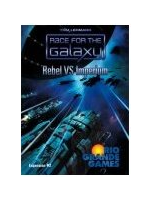
- Race for the Galaxy: Rebel vs Imperium
At first glance the second expansion kit for
Race for the Galaxy
appears to finally deliver on the all the military overtones
of the original. Rebel bases? Military takeovers? Surely
there's some inter-player combat hiding here somewhere, right?
Some chance to really hit the leader the way you've wanted.
Well, it has finally arrived. Among the new materials are
three new start world cards, enough action cards for a sixth player,
forty-one regular cards, military player tracks plus cubes to
place on them, and five goal tiles. The latter are probably
the most useful in changing up the usual game flow, the best
reason to get an expansion in this case. Three of them are
onetime goals – first to get eight cards, four goods or
three uplifts – while the remaining two are ongoing
contests – most rebel military worlds and explore power
cards. As to the military conflict, expectations may be frustrated.
The most important point is that only players with
military takeover capability need ever worry about it. Those
who do not are immune. Beyond that, combat usually does not
play that much a role. Players who do engage in takeovers tend
to stay on that path; they did so already, but now there's
even more incentive to do so. Combat is a matter of comparing
the difference between takeover strengths and the amount of
gain is limited by the amount of the difference, so even when
it happens what's taken away is not of overwhelming value.
Indeed, typicaly no combat occurs until near the end of
play and even then when a minor planet is taken,
the "victim" is at the same time playing an even
better one from the hand, with the result that both players
actually gain. Combat could have been implemented in a much
more chaotic way and no doubt some were hoping for this, but
that would have been too great a departure from this system of
careful planning and simply not fit. There's a lot of good
stuff here, but probably most don't need
this expansion. The system has so many unique cards that it takes
many playings to wear out their welcome. But if you're one of the
few for whom this has happened, this is an excellent bet.
[6-player Games]
HHMH7 (Strategy: High; Theme: High; Tactics: Medium; Evaluation: High; Personal Rating: 7)
Thomas Lehmann; Abacus-2009/Rio Grande-2009/Ystari-2009; 1-6
[Buy it at Amazon]
- Racko (Rack-o)
Simple card game first published by Milton Bradley in 1956
as Racko seems to be named after the style of the Marx
Brothers and also seems to have inspired the titles of later
simple card games Uno and Skipbo. In this one, each player
receives a plastic rack with ten slots for cards which are dealt
in randomly. Players substitute in cards from the draw or discard
piles trying to achieve strictly ascending order. First to do
so wins. The flavor is something like Gin
Rummy, especially with just two players which may be the
best way to play, although four racks are provided. Players can
raise their level of play by carefully noting what the opponents
discard, and from where in the rack. Figuring out what the
downstream player probably needs should greatly help in deciding
what to discard. Players who like the any of the above-mentioned
card games should like this one as well. Super Racko
appears to be a later expansion of the same idea.
- Radar Search
Two player gadget game consists of a stand-up board
which really must be seen, as at the Gamepile website,
to be fully appreciated.
One player controls two ships attempting to traverse the board while the
other a helicopter trying to catch them. The helicopter gets a radar fix
on them only every other turn. Radar is on the honor system, but apprehending
is not since when caught, the two pieces being stuck into the board will
connect to complete a circuit which gives off a loud buzzing sound. Actually,
it is possible to cheat in this as well as the helicopter player,
if quiet and fast, may secretly try various holes until success
is achieved. Bluff and mind games which should be amusing for
several plays.
- Rage
Trick-taking game based on Oh
Hell, but using a proprietary deck with additional cards
including jokers whose value may be set arbitrarily, cards to
remove the trump, cards to change the trump and cards which
add or subtract five points. While the basic game is already
random enough – consider how difficult it is to predict
one's tricks when only holding one or two cards – with
six different suits and values from 1 to 15, this version takes
the game to a whole new level of chaos. Although this version
supposedly accepts up to eight players, players will probably
be happier sticking with the original.
[English Rules]
- Rail Baron (Boxcars)
Players race around the historical tracks of America trying
to earn the most money. Structurally there are two halves,
each probably aobut twice as long as needed for the level of
decisionmaking. The first part is concerned with fulfilling
randomly-determined contracts and railroad acquisition. Owning
track permits cheap travel while running on other's lines –
which, akin to Monopoly,
is often required – profits an opponent. Contracts continue in
the second half with track fees doubled until finally someone
achieves the victory amount. Of interest is the design of one's
network as questions of connectivity, diversity and cost contend
with one another. But the experience is very much ride your own
waves with little concern for the plans of others apart from
the rather anomalous jump-the-leader feature at the end. In fact
the main task could be done much better by a computer, even if
not in the days of this game's invention (1974). Finding the
cheapest, most efficient route is made even harder by the lack
of any on-board indication of which track is owned by whom –
a communications design nightmare for beginners. To tedium and
difficulty add annoyance as most every turn players must pay
some trivial amount. It would have been much better to just
force players to keep some minimum reserve and get about the
same effect. Halve the costs of the railroads and the victory
condition if it's still desired to try this antique engine that
was no doubt inspired in its time. Most will find more obstacles
than they care to clear.
[6-player Games]
- Rails of New England
This is a wonderful labor of love partly inspired by the equally
wonderful
Silverton.
The incredibly-detailed map displays every last small town in the New
England of the Federal (early 19th century) period, each with its own
illustration. As a player you emerge from your own state and its your
task to link to all the major cities of the region. The challenge here
is whether to build quickly, but expensively, or more lucratively, but
more slowly and thus giving up things to the opponents. At the same
time there is an economic system that reflects the current state of
the economy – depression, normal or prosperity – which
plays out on a number of business cards that you draft and operate
throughout the game, an important decision being those you forecast
as worth keeping vs. those you will relucantly give up. There are a
great many historical touches from the Great Sheepocalypse (a player
term for the dramatic drop in wool demand) event to special benefits
and bonuses depending on one's state. Each faction is rather
distinct, not just based on board position, but also on special
rules that reflect particular historical conditions. The only
downside might be the "take-that!" cards, which feel out of place
and which are generally not worthwhile anyway as they hurt player and
playee to the benefit of everyone else. But it's not too bad: you
can easily just leave those cards out. Graphically this is very
attractive, strongly evoking the time period. Don't miss this
excellent game, only one of three in the
Silverton style, the third being
Dwarven Rails.
Walter H. Hunt & Gregory M. Pozerski; Rio Grande Games-2011; 2-5; 180; 10+
Strategy: High; Theme: High; Tactics: Medium; Evaluation: High; Personal Rating: 9
- Rails Through the Rockies (Rocky Mountain Rails)
Railroad game on that most popular of railroading topics,
construction of rails in Colorado. Others on this topic
include Silverton and
Tracks to Telluride (Colorado
Rails). The emphasis here is on finding the fastest and most
profitable route to Grand Junction, with the mining being far
more abstract than in Silverton.
It is more involved however than Tracks Through Telluride
as players must worry about the details of track types, passes
and tunnels. In addition there is an events deck which has
a large effect on play. As there are really only about three
good ways through the mountains, this is the optimal number of
players. There are possibilities for strategy, but is mostly
about opportunism.
[chart]
[Italian Rails]
- Railway Rivals (Dampfross)
Railroad game invented in 1973 by a schoolteacher for purposes
of teaching principles of geography. It does that and makes for
a rather satisfying game
besides. A hex map shows a region on which players draw track
in order to link cities and thus generate income. Then when all
cities have been linked come the races. Two cards are drawn and
whichever player or team of players can deliver a cargo from one
to the other fastest earns money. To figure out who is fastest,
a race is run with movement via dice, but having the most efficient
track helps considerably. Supported by a large number of map
variants including those set in:
American Southwest,
Bavaria,
China (largest),
Fidschi Islands,
France,
Germany,
India,
Ireland,
Isle of Man (smallest),
Kentucky/Tennessee,
Russia,
Spain,
Tolkien's Middle-Earth.
For more, see the
Railway Rivals map list.
Called Dampfross ("Steam Steed") in its German edition.
A possible inspiration for the
Empire Builder
series.
[Spiel des Jahres Winner]
[6-player Games]
[Periodic Table of Board Games]
David G. Watts; Rostherne Games/Games Workshop/Alga; 1973; 2-6;
also Laurin/Schmidt; 1983; 2-6
Strategy: Medium; Theme: High; Tactics: Medium; Evaluation: High; Personal Rating: 7
- Railway Rivals: China Map
This expansion map is made effectively large by use of many
small hexes. Each player begins at a different seaport.
In addition to the cities there are six border
areas which are also destinations: Vietnam, Korea, Manchuria,
Mongolia, Western China and one which may be a rules issue:
any seaport. That is, if the other end of the route also comes
up a seaport, is that invalid because of being too close or is
it permissible as long as the other city is at least six
spaces from a connected seaport that can be used? Players may
wish to discuss their interpretation before play.
Strategically, the map is busier than it looks in the
northeast; a player who can control it alone should do well.
Actually, because of the map's large size, it probably works
best with a full table of six players, at least if having a
lot of close races is a goal. The map's features are clear and
its plastic coating works well.
David G. Watts; Rostherne Games; 1987; 2-6
Strategy: Medium; Theme: High; Tactics: Medium; Evaluation: High; Personal Rating: 7
- Railway Rivals: Kentucky-Tennessee Map
Each player begins at either Nashville or Lexington. As usual
there are six border areas. The critical axis seems to be
east-west, primarily due to the difficult-to-crack Appalachian
mountain hexes in the east. The map seems to offer plenty of
opportunities for about five people, but seems too cramped for
more than that. This is a paper on hard board map which works
fairly well with the original crayons; erasure is clean though
some colors have difficulty leaving marks.
David G. Watts; Rostherne Games; 1987; 2-8
Strategy: Medium; Theme: High; Tactics: Medium; Evaluation: High; Personal Rating: 7
- Railways of the World: The Card Game
First there was Railroad Tycoon, a board game by Martin
Wallace and Glenn Drover, which after some changes gave way to
Railways of the World by the same worthies, which in
turn gave way to this one, losing the board along the way.
In that sense this card game is what would happen if
Ticket to Ride
met
Age of Steam.
Cards come in basically two types: straight tracks which
traverse the card lengthwise and cities which sit at the
center of a cross of track. Against this wholly square
alignment is the hexagonal starting space from which all track
building issues. But in terms of the layout that's okay
because the rules permit stacking track cards and also curving
their direction to avoid obstacles. Cities come in various
levels and the better the city the more track the player needs to
play it, which happens all in one turn. Thus collecting cards
to be able to play a city is a long-term plan and the hand
size is thirteen to accommodate. Building to a city scores
points based on its difficulty and at the end more points are
given, but to the player who has the most track connected to
each city. As in
Age of Steam
cities both produce and consume goods, those produced
appearing via random draw from a bag. Each city consumes
products in particular colors as shown on the card. In
addition to the cards mentioned before there are also wild
cards which serve either purpose, but can instead be played
standalone as engines, which determine how fast a player's
train moves when making deliveries. A player takes only one of
the above actions per turn so there tends to be strong dynamic
of setting up opportunities that opponents may take before the
player can. Replenishing cards is via draft, but taking a
wild card disallows the usual second draw. But no such
prohibition applies if one draws it at random from the stack.
There is some ability to address bad luck by discarding a card
to draw a new one or replenish a good, but is of questionable
value since it does use up a player's one action. Play ends
when the deck or bag is exhausted or a player builds the
maximum number of cities, and this comes much faster than one
expects, at least the first time. The presentation is
functional, if a bit drab. At least the colors of the cards
are supplemented by symbols for the color blind, though
nothing is done for the cubes side. There are forty-eight cute
little plastic locomotive pieces to admire. The instructions
are complete, but at times confusingly written, particularly
in the area of placing a city. There's a fair amount of
randomness here, both in the bag and card draws, which could
be frustrating, but at least it's short so if it happens it
doesn't linger. This isn't really the introductory game that
its card game form might suggest, but more a shorter version
of its predecessors that retains the same
complexity. It's really not bad, but exists in today's crowded field
of many railroading games where many will prefer the geography
of a board and others simpler affairs like
Ticket to Ride.
MMMM6 (Strategy: Medium; Theme: Medium; Tactics: Medium; Evaluation: Medium; Personal Rating: 6)
James Eastham & Steve Ellis; Eagle Games-2010; 2-4; 30; 8+
Amazon
- Rainbow
-
Not to be confused with the next entry, this card game hails from
Japan and is the fifth by this inventor. In a setup
reminiscent of
Lamarckian Poker
players bid cards to claim those on the table with their bids
adding to what can be claimed. These bids are done
sequentially and, if several of a kind or a straight, may
constitute more than one card, the best set taking the best prize
which goes into the personal score pile. The trick is that each
must play the same type of pattern as the starting player (shades of
Tichu)
or resort to just a single card. There are sixty
cards numbered 1-6, most of which are dealt out at the
start. It might be kind of annoying for some that
the card number is only printed on two corners of each card,
in case one tends to riff right rather than left. Artistically
it's nice that when cards 1 through 6 are laid out they form
a nice rainbow. The card artwork showing the countryside
beneath a rainbow and the large numbers in different rainbow
colors are well done. The instructions deserve praise too for
presenting the first page in a novel comic book form that makes
learning, or remembering the rules, very easy.
This is a game which is really too short
as it's over before it can really develop interest. Despite that,
is not interesting enough for the amount of time. Too much, it
seems, depends on luck of the draw, though it might work okay for
introducing some game concepts to kids.
LLMM5 (Strategy: Low; Theme: Low; Tactics: Medium; Evaluation: Medium; Personal Rating: 5)
Mito Sazuki; Grimpeur-2010/Japon Brand-2010; 2-6; 15; 8+
[Shop]
- Rainbows
Alan Moon-designed game of building rainbows, actually placing counters
on a grid to form connected chains. Tacked on is another sub-game about
building the best Rummy-like hand. There is a not a great deal
going on here, luck of the draw plays a large role and apart from nice
illustrations on the counters there is not much to recommend visually,
but it affords some tactics in a light and quick setting. Four players
is probably optimal.
Personal Rating: 6
Alan R. Moon;
White Wind-1995; 3-5; 30; 8+
[Shop]
- Raj
Card game which is a descendant of an Indian folk game and another
title, Hol's der Geier.
Characteristic of games of this type are that each player begins
with an identical hand and each simultaneously chooses a card
with which to compete, the winner taking the spoils. Strategically,
one usually wins this type of game by not trying to be too greedy.
If you calculate the amount it takes to win a majority of the points
and simply make sure you take small point values which sum to that
total and over which most players will not fight very hard, you will
do well. This system has been used and adapted for many other games,
Montgolfière and Sky Runner being examples.
Alex Randolph; 1995
- Raja: Palastbau in Indien (Maharaja: Palace Building in India)
-
A Kiesling and Kramer (just to reverse the usual order) game
which, like Knizia's Taj Mahal,
is about palace building in Mughal India. Are there a lot of
documentaries on this topic in Germany? The design team has
moved from Ravensburger to new publisher Phalanx, but the high
(low?) level of depth remains. Players represent princes and their
architects vying to build as many palaces as possible. Obstacles
are geographical – being in the right place at the right
time – monetary and the fact that a player has only two
actions per turn. These are simultaneously selected via a fancy
spinner. There are a wide number of choices including stealing
another's role, which confer special advantages in the tradition
of
Verräter
and
Puerto Rico.
Naturally this
may sabotage his plan completely. In fact the number of choices
a player can make is probably too large given the simultaneous
premise. That planning can be reduced to a near-meaningless
guessing game leads directly to the second problem: it is
very difficult for trailing players to cooperate on how to
stop a leader and there is no other catch-up mechanism. This
can even lead to the situation, unusual for a Kramer game,
that a player can be proven the winner turns before the
game is supposed to be over. Raja is that uncommon
combination of the tactical outing in a heavy format, the
primary example of which may be something as unexpected as Titan.
Fans of this and of guessing games like Aladdin's Dragons may enjoy
this even more intense realization, but it seems most others will
compare it more to Verrat
and feel disappointed, which is unfortunate given its lavish
production including a beautiful map and glass pieces.
- Rapa Nui
On Easter Island, or as the natives call it, Rapa Nui,
players begin with one lumberjack and three hunter-gatherers
who specialize, each player having a slightly different set of staples
they can gather.
A player turn is playing one or more of three hand cards
and then drafting
to replace from the bottom of four columns of four cards each.
After drafting, the last card revealed (a random one if the
column was thus exhausted) indicates a competition in that
category, each player getting matching scoring cards in the
hunter-gatherer type or wood in case of a lumberjack or
straight up points in the case of a priest.
There are, of course, also Moai cards depicting the famous
giant stone heads made on the island; playing one of these
costs seven wood (reminding of the theory that Easter Islanders
killed their civilization via unwise overuse of wood)
and forces each player
to sacrifice a scoring card, the activating player getting to
place his face down and also use another one from the supply.
At the end of play all of these scoring cards are revealed;
player copies of the most frequently chosen card are worth 4
each, the second most chosen 3 each, etc.
Although the system seems susceptible to problems in certain
configurations –
in a three-player game, two may very well cooperate to
raise what is in effect a stock price of a commodity, leaving
the third out in the cold – it is also fairly harmless and does
not overstay its welcome. This system works well, but was
cleaner when it was called
King's Breakfast,
though this one's support for two-player situation is an
improvement. There appear to be strategic considerations in
terms of what to specialize in, but likely these will be
dwarfed by which cards are available on one's turn.
The artwork, as is usual from this publisher,
is attractively realized. That this one, coming from the
teacher who invented
Carcassonne,
has a mild educational flavor may attract. Along these lines,
lists of other games about Easter Island
or other places are also available.
MMMM7 (Strategy: Medium; Theme: Medium; Tactics: Medium; Evaluation: Medium; Personal Rating: 7)
Klaus-Jürgen Wrede; Kosmos-2011; 2-4; 40
- Rasende Roboter (Ricochet Robot)
Actually a puzzle about programming a set of robots to achieve a goal
in the most efficient way. As a game it is almost in the party genre
as players can easily jump in or drop out. There isn't much in the way
of strategy.
[6-player Games]
Alex Randolph; 1999
- Rattenscharf (Rat Hot, Dschunke: Das Legespiel)
-
Two player tile-layer by Michael Schacht, whose German title would have
been more accurately and sensibly translated "Sharp as a Rat".
Players draw tripartite
tiles at random, playing them to connect identical images of
their own color and inhibit same by the opponent. Tiles may be
stacked atop one another. If you're very good you can even
engineer 4-point plays in which both illustrations on a tile
score. Such planning is occasionally disrupted by the appearance
of one's rat tiles for if ever 3 of these are visible, the owner
loses immediately. So the player is entertained constantly by
multiple conflicting goals: short-term points, long-term points,
inhibiting opponent points, covering rats, making opponent
rats hard to cover. (No tile may overlap another directly,
but must partly cover at least two.) All is so nicely balanced
that most of these goals can be accomplished, but just barely.
Turns should move along speedily, but beware opponents who
eschew intelligence in their placement and fall back on brute
force tryings of every, last, possibility. Then you're in
for a long and boring time. Thematically, the idea is that the
players are storing food as efficiently as possible.
In the metaphorical sense the suggestion
that problems can just be boarded over and ignored certainly
has resonance in modern life and public policy. But this is a
good example of a marginally themed game good enough not to need one.
The color blind may not be happy here since even though the green
food and the red food come in different packages and so are
distinguishable, these are poor color choices when it comes to
the rats. Otherwise, recommended for all audiences.
[Frequently Played]
Strategy: Medium; Theme: Low; Tactics: High; Evaluation: Low
MMHM8 (Strategy: Medium; Theme: Low; Tactics: High; Evaluation: Medium; Personal Rating: 8)
Dschunke: Das Legespiel:
This earlier web-published version featured similar tiles, but
slightly different rules. There was no concept of the knockout;
instead all scoring was only at the end where each combination
scored according to the triangular numbers scheme and each visible rat
deducted one from the score. It's probably too difficult to play
this set using the later rules because some of the tiles contain
double rats of the same color.
- Rattus
Rattus rattus being the scientific name for the common
black rat,
this Norwegian-invented game takes a look at the Black Plague
outbreaks in Europe from 1347 and onward. The map shows a Europe
divided into just twelve regions having names like Hispania,
Germania, etc. These are randomly seeded with face down rat
tokens. Players then start the board by placing two pairs of cubes,
representing people, into any two regions. A turn consists of
choosing a role card, placing cubes into a region equal to the
number of rat tokens there and moving the plague pawn to an
adjacent region. Role cards have names like king, knight,
merchant, monk, peasant and witch and each provides its
chooser, only, with a special ability. Examples of the
abilities include being able to move pieces, rats, or the plague
pawn, add more cubes than usual, examine hidden rat tokens or
move pieces to a palace area where they are always safe. The
plague pawn causes more rats to appear in its region and
also in adjoining regions up to a maximum of three. After
every player has had a turn, the rats in the plague region
are revealed and depending on their indications, cubes in that
region and cubes belonging to players holding particular roles
are lost. There are also often special losses for the players
having the majority of cubes in a region. All of this
continues until there are no more rat tokens to place or a
player empties his supply of cubes. At that point the player
having the most cubes in play wins. The map and components are
attractively made. There is a weird, glossy finish to the board,
made perhaps, in China, but it, the large cubes and plague pawn
are easy to use. What's also well done here are the rules by which
the rats and plague strike and spread. They keep the game from
breaking down one way or the other and yet are elegantly
implemented. What's less admirable is that the theme really
makes no sense as who are these people represented by cubes
coming into Europe? And what of the millions already living there?
The roles are only slightly better in this regard. Then too,
the "reveal rat tokens" mechanism can strike rather randomly
and unfairly. This sits uncomfortably beside the seemingly
strategic role cards and can easily render their functions
meaningless. In other words, your genius plan vis-à-vis
card strategy may well be rendered useless by the vicissitudes
of random draw. In addition the rules are not well written,
frequently depending too strongly on examples alone to illustrate
rules. Still, this is apparently fairly popular as there have
already been two expansion kits.
Rattus: Pied Piper (2010)
adds the role cards crusader, courier, soldier, mayor,
emperor, pied piper, serf, queen, wizard, baker, nun, bishop,
while
Rattus: Africanus (2011)
adds northern Africa to the map. What then is the appeal?
Perhaps it is the relatively short play time and the
effectiveness of the illusion of control, especially among
play groups having unequal skill where large doses
of luck are more welcome.
MLHH6 (Strategy: Medium; Theme: Low; Tactics: High; Evaluation: High; Personal Rating: 6)
Åse & Henrik Berg; HUCH! & friends-2010/White Goblin-2010/Z-Man Games-2010; 2-4; 45
Amazon
- Raubritter (Robber Knights)
-
Rüdiger Dorn tile laying game for up to four. The next time he
is interviewed the inventor simply must be asked why he is so
taken with the idea of placement by adjacent squares, which
appears here as it also did in
Traders of Genoa,
Goa,
and others.
In this one each player works through his own set
of tiles, which have been programmed into several sub-decks. The
player has a limited hand size à la
Samurai
and as in that game often wants to delay doing much until a good
opportunity is available, e.g. a scoring opportunity which cannot
be undone. Tiles come in three basic types: places to score
points (municipalities), obstacles (lakes, mountains, forests) and
places generating pieces (castles). Pieces are moved exactly once
and attempt to cover point tiles in a straight line from their
source, preferably over-topping other player tokens. The problem,
however, is how to keep one's own tokens from being subsequently
covered, which is where blocking terrain and stacking limits come
in. As the board fills up, there are more opportunities to hide by
using the board edge as a barrier; this is a game decidedly to
the advantage of the patient participant. But it makes a mistake
with first timers, however, whose first instinct is to
immediately use their blocking terrain – it appears useless
after all. In reality, these are some of the more valuable tiles
and really deserve to be saved for a judicious opportunity. The
game's instructions rather than this review really ought to be
the ones helping players realize this. Now seems a good time to
mention Friedemann Friese. Not because he has anything to do
with this became, but because he and his 2F-Spiele show great
courage in choosing themes, often modern ones, which avoid the
trite old topics like pirates, ancient Egypt and here, for the
one millionth time, medieval Europe. Not only has it outworn its
welcome, but it in no way fits, the reasons why being safely left
with the reader. Meanwhile and ironically, this is not far from
a diceless version of
Indus.
Overall the system is reasonable and seems like it ought to be
more fun than it turns out to be, perhaps a consequence of its
intermittent nature. Unless perhaps in two-player mode, every
turn is an opportunistic one and it's hard to plan for much more
than one turn in advance. There may be a slight advantage to
being the last player as well. Tacticians should be the main
audience, but even they may be left unexcited by the somewhat
static nature of this.
Strategy: Low; Theme: Low; Tactics: Medium; Evaluation: Low; Personal Rating: 6
- Ravine
-
Apparently meant as a sort of party game that you tell stories
about later on. Felt like it wants more agency and decision making
if it were to be a strategy game. Rating of 7 is for what I believe the
creators were going for.
- Razzia (Hick Hack in Gackelwack, Pick Picknic)
-
Card game set in Prohibition-era American city. Players
have a nebulous identity as they control both police and
gamblers who each turn visit favorite nightspots such as the
Cotton Club, Havana Club and Jazzhouse. Reminiscent of Adel Verpflichtet, in that cards
are simultaneously revealed and some (police) may catch others.
If there are multiple contenders, they may attempt to settle
matters via negotiation, but if this should fail, dice are
resorted to. Title translates to "Raid". Republished in
2001 as Hick Hack in Gackelwack and transferred to a
barnyard setting (chickens getting grain and avoiding foxes)
with typically-attractive illustrations by Doris Matthäus.
Main changes include cash tiles being replaced by different
colored cubes and "-2" chicken cards which allow the player
to steal a single low value grain, but deduct points from any
nosy foxes. Both versions make for an interesting bluff and
mind games experience that does not overstay its welcome, even
if occasionally unfair if one draws mostly low cards or not the
cards one wants. One of those games for children that adults
can enjoy without strain, it would seem to make an ideal product
for English-language release. [Holiday List 2002]
[6-player Games]
[Top Ten Gateways]
[Top 10 Games for 7 or More Beginners]
Strategy: Medium; Theme: Low; Tactics: High; Evaluation: Medium; Personal Rating: 6
Stefan Dorra;
Ravensburger/Zoch; 1992/2001; 3-8/2-6
- Ready to Take Off
Light card game consists of using jet aircraft cards (why?) to bid
for airline routes, which are just numbers on other cards.
The routes have intrinsic values, but the main
points are achieved by collection of matching sets, each route naming
three cities. There is nothing very compelling here;
For Sale
is a more engaging light auctioner, and less dependent on luck.
Often simply referred to as "Take Off".
- Really Nasty Horseracing Game, The
Both wagering and horse ownership concern players over six
races. Nastiness enters mostly in the form of "take that!" cards
which can fell a horse in a single blow. Lesser ploys involve
stopping in front of an opponent although the only effect is to
force an unfavorable lane around the turn. Movement is by die roll
– only a "6" permits a move to the inside. There are bonus
spaces permitting a double move if the horse is of sufficient
quality, each player fielding an identical stable. Each race pays
the owners for win, place and show, but the secret wagers only
pay off on a win. An obvious tactic is to bet on someone else's
longshot and be prepared to hobble one's own horse should it
turn out the accidental leader. Despite its old-style mechanics,
this product of 1989 still works surprisingly well. Part of this
must be the no-nonsense treatment of catastrophes. Rather than
be slowly crippled by a thousand cuts, horses either race at full
speed or not at all. This ensures fast races, full of anxiety and
excitement with no time for boredom. While the events can cruelly
dash hopes, at least they are balanced and not numerous. A good
example of a chaotic game that works, this is considerably more
fun than the overwrought Win, Place,
and Show. Another reason for this is no doubt the large,
fully-modeled horse-and-jockeys. The instructions contain
ambiguities which will have to be decided by play. What ensues
if a horse is blocked on the outside lane is not explained nor is
it clear whether moving to the outside costs movement pips or not.
[6-player Games]
- Rebound
Dexterity game for two where each controls four marbles locked in
round plastic jackets. As in Horseshoes, they take turns
pushing the marbles down a plastic alley where they bounce off
an A-frame of two rubberbands and double back along a parallel
alley. The goal is to land in a location with a high score –
the alley is demarcated 10-20-50-100 – or knock the opponent into the Pit.
A newer version features green and purple jackets rather than the more traditional
red and blue, higher point zones and tilt area. Amusing for children, but
ultimately tiring.
- Reef Encounter
Multi-player game of coral and shrimp existence on a reef by
Richard Breese. There are echoes of his
Keydom
in that players compete in a certain way (here to consume the
most), but someone can always move the goalposts (which ones
are worth the most). Even the rules of which corals dominate
which can be reversed. There's also a lot of use of side effects,
which can make learning the rules harder as completely separate
sub-games get artificially linked together. For example,
use of a shrimp permits guaranteeing a particular dominance
rule. Guaranteeing a dominance rule reverses other, unrelated
dominance rules. As you may have gathered, amidst all of this
domination, there's an almost war game feel with players able
to predate one another's holdings, although this is ameliorated
by the fact that eventually the player will consume his entire
position himself. Meanwhile it gives rise to the interesting
sub-game of how to position one's coral on a square grid with
obstacles. One's shrimp can only protect orthogonally adjacent
corals so the question is "how can everything be positioned
to maximize protection?". Or, should the goal be to maximize
consumption of others' corals and defensive position be hanged?
A good memory for what players have drafted won't hurt. The
presentation (by Ludofact) is quite high, much better than
the typical independent production. Topic and play are
innovative. Its complexity is a bit much for the casual player,
but most of those who can handle more should enjoy this, the
largest lingering doubts being in the area of luck of the draw and
in the longish, solitairish turns. 'Tis a quiet, thoughtful game
for those who can appreciate such. One irony: with all the epics
he made, who would have thought that the game with a title taking
off on a Richard Burton movie would choose Brief Encounter?
Second edition: The new edition is much the same, but with
slicker graphics. Sometimes they are a bit too slick; features
like the holes in the reef are so mildly depicted that players may
forget they exist. The passage of a year revealed that the game
in general has not aged well. What one can do seems entirely
tactical and subject to chance as one must draft among items which
are often almost all useless, and even if they are not, may well
be rendered so by the large changes which will occur before one's
next turn. Like
Mall World
it truly tends to defy analysis. Meanwhile it still suffers from
poorly outlined options and the thousand cuts of many rules
exceptions.
Strategy: Low; Theme: Medium; Tactics: Medium; Evaluation: Low
- Reibach & Co. (Get the Goods)
Alan Moon card game in which players try to collect sets and
score points at random intervals provided by scoring cards. This
otherwise enjoyable game of groupthink is unfortunately marred
by original rules which don't quite work. Thus, players must
agree beforehand on which of several rules variant sets to employ.
Title is a bit of a pun as einen Reibach machen means
"to make a killing".
Strategy: Medium; Theme: Low; Tactics: High; Evaluation: High; Personal Rating: 8
Alan Moon & Mick Ado; 1996; F.X. Schmid; 2-5
- Reise zum Mittelpunkt der Erde, Die (Journey to the Center of the Earth)
This realization of the Jules Verne classic is a game in three
parts, both visually and in terms of its systems. Part one is
the descent of three adventurers. As in
Expedition,
no one controls any single color – a player can activate
any during his turn by playing a matching color card for each
move across the square grid. This volcanic interior contains
both obstacles and prize spaces. Traversing the former or
earning the reward of the latter requires play of the
corresponding equipment cards, e.g. rope, compass, lantern,
etc. The compass, pickaxe and hardtack, can also
confer extra movement abilities. Prizes come in the form of
relic cards – drawn at random to provide victory
points as parts of various set collection sub-games –
and water tokens (blue glass pieces) which prevent the loss of
relics at the end of this stage. A player who cannot or will
not move an explorer instead drafts cards of either type;
person cards are always face down, but three equipment cards
are always face up on offer. Part two begins when a player
earns the bonus points moving an explorer to the edge of the
lake. At this point all three explorers are fitted into a raft
and travel together. As the lake is also studded with obstacles
and rewards, play is much the same except that upon landing on
an award space, not just the active, but all players can reveal
matching tools to claim relics. But in addition, each lake
movement triggers revelation of a random lake card against
which either the current or all players discard matching cards
to either avoid a penalty or obtain a reward. This stage is
substantially faster than the first, but still longer than the
next which is very quick indeed. In part three the travelers
are still together, now emerging from a different volcano.
They move a random number of spaces upward and depending on the
ending space must produce explorer cards of the matching color
or lose relics. Players then compare scores which until now
have been entirely hidden except for the number of cards held.
Graphically this is a fine production with the estimable Franz
Vohwinkel up to his usual high standard. The only complaint
might be that the edges of two types of equipment cards are a
little too similar. The explorers are identical plastic
figures, apart from their colors, which fit securely into a
nice plastic raft. Curiously, complexity and the level of luck
seem to match that of that other recent Verne vehicle,
Around the World in 80 Days,
i.e. this is probably not one for the strong fans of this inventor's
Goa.
Although it doesn't go as far as assigning variable explorer
abilities, it does make a run at theme and perhaps more
significantly, there is no way to target an opponent, or even
be sure who is leading. This might easily appeal to those
wanting to avoid direct conflict in their gaming.
Rüdiger Dorn; Kosmos/Mayfair; 2008; 2-4
Strategy: Low; Theme: Medium; Tactics: Medium; Evaluation: Medium; Personal Rating: 7
[Buy it at Amazon]
- Res Publica
Reiner Knizia card game centers around trading and set collection.
The innovative mechanism is that the player wishes to arrange a trade,
but may only state either what he wants or what he wishes to give away,
but not both. This makes for some interesting considerations, but does
not seem to work very well at the top end of the number of players where
things become very static and slow.
- Rescue Heroes Pet Rescue
Fisher-Price (Mattel) game intended for ages 3+ is a re-working of
Snakes and Ladders transported
to the scene of a burning building. Players work their way up from
the ground floor by rolling to move. Upon landing on a tile, they
flip it over to reveal which animal they have rescued. Ladders
move the landing player up very fast while ropes drop them
down. The game ends when the first player reaches the waiting
helicopter on the roof. Whoever has the most animals at this
time wins and automatically rescues all the rest of the animals.
It is difficult even for adult players to tell what the direction
of travel is since the only indications are the ascending numbers
printed very small in the spaces. Arrows would have helped a
lot unless the idea is to teach counting. The standup plastic
figures fall down quite easily and are thus wholly unsuitable
to their role as player markers. Noting that there is a whole
line of collectible Rescue Heroes figures, this game appears
to be nothing more than a cheap attempt to give them something
to do and thereby enhance sales of further such figures. [Fisher-Price]
- Resistance, The
Strategy games that employ the team vs. team concept intrigue
as they're rather rare. Curiously, apart from party games like
Pictionary,
these usually feature the concept of one or more traitors or
villains whose identity as members of a different team is
hidden. Examples include
Shadows Over Camelot,
Saboteur,
Castle of the Devil
and
Battlestar Galactica.
But probably the closest analogy is to
Werewolf
as this inclines to its rather simple format, though not
nearly as much. The theme is a group of revolutionaries
ostensibly attempting to solve missions. However, at least
one and maybe more are instead secretly trying to sabotage them.
First players vote on the rotating leader's proposal of which
players to send on the current mission, which may lead to more
proposals until one passes. Then the chosen players each
submit a face down card indicating whether they are working
for or against the mission. The cards are mixed and revealed.
Three solved missions means a win for the larger team; failure
to do this in the predetermined number of rounds means a win
for the spies. What's good here are that everyone plays the
entire time – no moderator needed and no player elimination.
It's not without its frustrations, however. In one playing
this reviewer happened to learn the identities of both of
the spies because there were only three players in the mission
and he himself wasn't a spy. Well and good, but so much for
the fun of deduction. Not only that, getting the other players
to believe the truth just learned proved very difficult, even
if ultimately successful. One idea for doing so was to predict
what the spies would do, i.e. that they would choose one
another to include in missions when the leader. This put a lot
of pressure on the spies as they did not want to thus confirm the
accusation. Thus they instead picked the least experienced player
and hoped to mislead the rest. This was only a six-player
outing and it may reveal a significant point: that this works
best with at least seven. On the other hand, this task of
advocacy may for some players simply part of or even the
majority of the fun. The rules writing can be a bit vague
at times. Thematically this isn't particularly strong either.
Time and place are vague; there's never any point of
paying attention to exactly what the mission is or any chance
that it can go wrong for a random, i.e. non-player reason. The
sort of dark-feeling artwork is merely window dressing.
Probably, even though there is a theme, it's so light that
this should really be classified a party game. Another nice thing is
that it's a party game that supports ten players using a
fairly small package.
[Party Games]
LMMM6 (Strategy: Low; Theme: Medium; Tactics: Medium; Evaluation: Medium; Personal Rating: 6)
Don Eskridge; Indie Boards and Cards-2009/Heidelberger Spieleverlag-2009/Wargames Club-2009/Hobby Japan-2009; 5-10
Amazon
- Restaurant
Fairly light and a bit like Fossil. In the first half
the tables get "seated" player by player orthogonally and in
the second half they get "served" in the same way, but in the
backwards direction. Very important to gauge what the player to
your left will do, indeed to gauge what everyone will do before
it is your turn next. Game can end much earlier than expected
if players are not careful or even one desires it. Probably
there is too much individual control to satisfy most players
– perhaps further development could have made this a very
interesting game. [6-player Games]
[more]
- Rette Sich Wer Kann
(Seenot im Rettungsboot; Lifeboats)
Very psychological game has won itself a unique reputation by
forcing players to deliberately ruin the hopes of others based on
nothing at all. Called "Save Yourself If You Can", "Every Man for
Himself" or just "The Leaky Lifeboat Game", the theme is
a number of boats trying to reach shore while each turn a number
of occupants get left behind. Must be played with
the right group otherwise these continuous opportunities
for spite and malice can have unfortunate results.
Intrige is something like this. It's also part of a group of
racing games in which players can mess up others, like Karawane
and Igel Ärgern. The difference here is that there's very
little randomness.
If you enjoy managing others' emotions, this would be for you;
otherwise, probably not.
Seenot im Rettungsboot (Lifeboats).
The 2006 edition is a good reproduction of the original – the
boats and pawns seem nearly identical. Cards have replaced the more
fancy voting dials, but they were somewhat fragile anyway.
The instructions for the
English edition are well-translated and illustrated in full color.
The only quibble might be that the sequence of phases is a bit
unnatural and so it would have helped to print it on the board,
in iconic form at least, if letters are so abhorrent, as they
everywhere seem to be these days (why is that?).
[6-player Games]
Strategy: Low; Theme: High; Tactics: Medium; Evaluation: Low; Personal Rating: 4
Walter Müller's Spielewerkstatt;
- Rette Sich Wer Kann [Crocodile Pool Party]
Morbidly weird two-player game of crocodiles turning up in a hotel
swimming pool and devouring not just the guests, but each other. I
can't imagine how inventor Rudi Hoffmann and/or publisher Kosmos
came up with this topic, but it does illustrate Hoffmann's
continuing love
of the grid. Here it contributes to a special
kind of game math as each croc can move a different
number of spaces in orthogonal steps, usually with just one
turn permitted. A lot of time can be spent understanding the
resulting geography and what it takes to move to a position where
one can strike, preferably at multiple targets in a classic Chess
fork. It is also a bit reminiscent of the inventor's Tally Ho,
but there are fewer pieces and more analysis. It's also not
quite as good thematically – that crocodiles are eating
other, fully-grown crocodiles is bothersome. Also annoying is
the fact that the box quality is less than the previous games in
the Kosmos two-player series, probably an artifact of worsening
economies. Other than that, this works fairly well as a short,
analytical jaunt.
Rudi Hoffman;
- Revenge in Rome
One-time use mystery party game is nicely done with plenty of
scope for role-playing if the players are willing to get into
the spirit of things. Revelations about the characters will
cause plenty of fun and need for improvisation.
[Party Games]
- Reversi (Annex, Annexation, Othello)
Traditional game which began as Annexation or Annex,
a Game of Reverses in 1870 in England arrived in the
United States as Reversi in 1888 via McLoughlin Bros.
Becoming popular again in the 1950's, in 1976 it was marketed
by Gabriel as Othello (following Shakespeare's play
apparently because the game featured pieces in black and white).
A two-player abstract with black and white pieces on a grid,
it is likely a descendant of Go. Here,
however, there is a white side and a black side to each token,
the object being to outflank the opponent by having one's disks
on both ends of a row. This flips the opponent's disks to the
acting player's color.
If flavorless and lacking in variety, there is certainly strategy,
albeit a bit shallow for the taste of the experienced game player.
[10 Most Famous Board Games]
- Revolte in Rom (Roma)
Another of the two-player card games which, like
Lost Cities,
Schotten-Totten
and
Ballon Cup
are fought out over a line drawn between the players. Locations
are numbered 1-6, against which each player can play a single
card. On a turn a player rolls three dice and can activate
cards at these locations. In addition, two other locations
permit drawing cards or money, and in proportion to the number
of pips showing (hint: place your most useful cards on the lower
numbers). So the system is neat and simple, but gets intriguing
due to the wide variety of cards and the powers they offer. But
the cards show only icons to hint as to their meanings so at
first there is plenty of rules referencing (make a photocopy),
but on the positive side there is a nice thematic connection with
the meaning of each. Gladiators, legions and assassins attack;
fora and other biuldings provide victory points, etc. The many
special powers interact, sometimes in surprising ways, and
many games will pass before they are all explored. Then there
is the puzzle about how to position against the opponent. Amid
all these positive features there is also the problem that the
game can fall off the rails awfully fast. A player may have too
deadly a forum combination or maybe the first player is able
to blitz the other too hard on turn one and keep him from ever
getting into it, or maybe it's just good lucky dice rolling
or card drawing, but don't be surprised at a sudden victory as
they are common. On the other hand, it's easy to just set up a
new game. This offers a lot of variety for fans of quick games
who don't mind a high degree of asymmetry. On the whole it is
probably has more straightforward fun than
Hera and Zeus
if less bluffing and planning. This game was followed on by
Arena: Roma II,
which is both a successor and an expansion.
[Frequently Played]
Strategy: Low; Theme: Medium; Tactics: High; Evaluation: Medium; Personal Rating: 7
Stefan Feld; Queen; 2005; 2
[Buy it at Amazon]
- Rheinländer
Reiner Knizia tile-laying game set amidst the curves and castles of the
Rhine River. Handsomely produced by Parker Europe, it seems to be a
game whose charms and subtleties are not revealed until after several
plays. Two basic strategies seem to be either to get as many dukes on
the board as possible or to try to make as large a duchy as possible
and with it swallow the duchies of competitors.
Three-player games tend to favor the former and five-player outings
the latter. There appear to
be some interesting tactics as well in the Archbishop and in
two players managing to alternately buy out one another's duchy.
As in many Knizia games, the player forms strategies based on
a risk-management analysis of a variety of events which may
occur and then decides whether to take an opportunity when
it presents itself. Likewise for preventing possible future
opponent opportunities. Production-wise, instead of cards, I
would have preferred tiles kept in a bag because of the frequency
with which reshuffling occurs.
[FAQ]
- Riffifi
Stefan Dorra-designed light game very loosely based
on the safecracking activities in the classic film of the
same name. Players continually "sabotage" their opponents by
playing cards of the same suit, but lower. But if no one does
so, the player collects chips equal to that number. As with the
designer's For Sale the result is
an interesting, short outing. Similarity with the author's Land Unter is probably even more
pronounced. A good memory for which cards have been played is a
definite asset.
Stefan Dorra;
Winning Moves Deutschland;
- Rigatoni Intriganti
Oliver Igelhaut and small publisher Glücksritter game
about noodle-making employs as tokens actual pasta shells!
Interesting idea which permits players to choose from one of
four different victory conditions may be a bit problematic since
a player lucky enough to be different from the rest stands to
benefit. Situation is very unstable and victory achievable without
players even noticing. Players must be very alert or it can all
be over in as few as just three turns. Players frequently need
to subsume their own goals in order to play defense, but this
is problematic as on top of the natural reluctance, it is not
clear just how much defense is needed. Also features diplomacy
and negotiation rules for takeover attempts which work much like
those in Cosmic Encounter.
Event card handling is nicely handled as a player can draw as many
as desired, but four cards in the deck are disasters. A house
rule which assigns each victory condition to one of the aces
in a standard deck and then secretly dealing out the aces might
make the situation more fair. It just might be that this game is
very successful if played a number of times by the same group to
bring out the nuances that a casual first outing does not reveal.
- Road to Canterbury, The
The inventor has moved past a previous obsession evident in
Bridge Troll and Trollhalla and onto a
very good one: the medieval collection of tales by
Chaucer, a seeming good topic, but not one that anyone has
realized since
Hazard.
This one is basically a card game, the unique cross-shaped
board formed by a central square having four flaps, barely
being needed. The narrative centers on just one of the
stories, "The Pardoner's Tale", all players being pardoners.
Chaucer does not seem to have liked the disreputable pardoners
very much, depicting them as people who abuse their authority
and grow wealthy by selling fake relics and keeping the
money for themselves rather than donating it to the Church.
Thus players inflict themselves on seven
non-player travelers making the pilgrimage to Canterbury by
first inducing them to sin, represented by playing cards
each representing one of the seven deadly sins to a character.
Later play of a pardon card matching the character's sins earns
money depending on how deeply into that sin the character has gone.
As a side effect,
a token goes on that character. But there is also
the possibility of things going too far. When the character
acquires seven sins or a randomly-drawn death card, death is
the result and whoever pardoned most earns even more money.
Should there be a tie, a good and interesting rule is that the
player having the most sins in hand takes precedence, giving
players a significant tradeoff in composing the hand,
especially since sins are probably the least valuable type of
card in general.
In addition one board flap depicts the actual road to Canterbury –
imagine that – and at each death there is an evaluation, the
most pardoning player or players being able to put markers on that
station on the route to earn even more, the value going up as
the group gets closer to their goal.
As a side effect, each sin played permits putting a
token in the corresponding sin space. Getting a marker in all
seven spaces is a very valuable accomplishment, the first
player earning twenty, the second ten and the third five.
There are also relic cards which have
humorous names and wild, rule-breaking effects. First time
players beware; you have no idea what they can do, or that some are
quite a bit better than others.
The production and artwork, including the work of
Hieronymous Bosch
in the center square is distinctive and not much like other
games – in other words, great. It also does not last overlong,
even with three. But that hits the first problem: it can only
support two or to three players, limiting the number of
situations in which it can be played, and how many games like this
can a collection stand? It's a game of
putting out pickings for others and then being first
to scoop them back up, in some cases the decision being
who is willing to sell out first. But this ends up feeling like
not much more than play-a-card-draw-a-card. The decisions are
that obvious. And then way too much of it is luck of the draw,
as by no fault of one's own one can spend a whole game trying
to get that elusive card needed to finish the seven deadly
sins series. Worse, the same applies to
getting the right sin or the right pardon or the right relic.
This is true even though three of each type are available
for drafting, as is the top of the deck. As a consequence
it's not watching paint dry, but comes a close
second. Probably all this stems from trying too hard to fit its
theme, but even there reach exceeded grasp. The sin
and pardon cards dully display only those words, so we
never feel any sense of story about how a pardoner tempted the
poor sinner or what they sold to "save" them. The relic cards
do only a very little bit, and it's likely one shouldn't draft
these cards anyway. There is a little bit here, but to find
sustained interest it needed to have substantially more.
It should also be asked why the deadly sin
Lust is being rendered Luxury. Using this archaic term
obscures rather than clarifies its meaning; is this just to
avoid offending someone? The instructions also state "Please
note that the game parodies the corruption of religion. It is
not intended as a parody of religion itself, or of any
particular religion." Is this really necessary? If the game
makers think that our common state of reason has departed so
far that we cannot discern this, why are they even bothering
to publish a game at all, for who would have the degree of
rationality needed to play one? In any case, be rational and
play something more interesting than this one.
[Tourist Games]
LHML5 (Strategy: Low; Theme: Medium; Tactics: Medium; Evaluation: Low; Personal Rating: 5)
Alf Seegert; Gryphon Games-2011; 2-3; 60
Amazon
- Road to the White House
Multi-player game about the US presidential election feels similar
to the earlier Campaign Trail
by another publisher. The historical fact that only the two
major parties can elect a president is here avoided by making
the game mainly about the primaries with the general election
being playable as a variant. As before, the emphasis is on the
road the candidates must travel, success in a state depending
on time spent there. One major change is that the "must move
full distance rolled" rule is gone. Instead, the candidate and
his surrogates move only one segment, the length of the segment
getting longer as dice pips increase. Candidates have very
detailed characteristics and issues play a role. Events pop
up whenever a "1" is rolled on the four-sided dice, but often
have no effect at all if they match no player's issues –
an annoying interruption of play in that case. But even more than
in the previous version, the emphasis is not on playing a game,
but on simulating the experience of the manager of a national
political campaign. At this, it succeeds very well, perhaps too
well for there are so many numbers, modifiers to numbers and even
modifiers to modifiers to numbers that it seems rather unfair for
the players not to have the spreadsheets that their real life
counterparts enjoy. Instead all each has is a single sheet of
paper that doesn't even show the states in order of most to least
electoral votes. By the way, this is only the basic game. The
advanced adds roll-your-own candidates and a schedule of primaries
for those who want to guarantee a nervous breakdown. What was true
of its predecessor is even more true here: it would be better
played via e-mail. There are a few quibbles to point out should
the inventor of the next "road" game be reading. Rules like the
one which prevents use of a priority flight out of size 1 city
are exceptions which really don't add anything, but do annoy and
subject Fun to the death of a thousand cuts. There are rules
ambiguities as well, e.g. can a candidate debate a surrogate (i.e.
flunky)? can a surrogate's presence be extended? etc. Actually,
the whole idea of surrogates seems rather dated, their degree of
influence in these days of instant and pervasive media rather
muted . A better approach might be more of a state machine,
each candidate having a rating in each state which fluctuates
based on events and activities. The support of the governor in
a particular state is probably the more major influence these
days. The component quality is generally fine, but the pawns
are too large for the board spaces on which they travel as they
manage to completely obscure exactly what the player most needs
to read. Some translucent chips (Bingo style), perhaps
with crosshairs drawn on, would have worked much better.
- Roads and Boats
Sort of a Sim City meets board game with apparently almost
no interaction, but is absorbing simply trying to
figure out the best way to remove all the bottlenecks from
your production and optimize one's layout. This is the kind of game
that would be good for several hours of solitaire. It also
appears though that this one too would be susceptible to
a player doing something "weird" and sort of "ruining" the
game thereby.
[Jeroen Doumen]
[Splotter]
- Robin Hood
Card game by Amigo about forming "straights" and "triplets", using
them to claim treasure cards. Randomness of a card deck and a limited
ability to draft create some interest, but it seems to go on rather
indecisively about twice as long as it should. Theme falls down as well
whenever the Merry Men steal from one another, i.e. most of the time.
- Rockets
Very simple game in which up to four players attempt to be the first
to reach the moon via play of cards to move rockets along a path.
It is mostly a guessing game in which one tries to play high cards
which however differ from the cards played by the others. Luck plays
a crucial role.
- Roll Through the Ages
Just when we might sigh over the end of recent spate of dice games,
here comes another. Lately some titles such as
The Settlers of Catan
and
Ingenious,
after establishing a big success, have appeared in travel
editions. Bucking the trend, this one's first edition is
in travel form already. In a tight box are seven wooden
dice, four peg boards and a couple dozen pegs in various colors.
It's a pity that amid all this wood there are none of the pencils
needed to mark up the score sheets. But on the other hand, where
would they fit? The idea here is that, much as in the purchasing
part of
Civilization,
one is making progress on interrelated technologies. A player begins
with three cities which permits rolling three dice. Each has
six different outcomes, viz. food, workers, food or workers,
money, goods, or two goods with a disaster. Workers can be used
to build monuments, which earn victory points, or more cities.
Food is needed to avoid losing points for not feeding workers.
Each goods result adds another type received on the turn.
Goods want to be collected in the same types to earn values that
increase at better than linear rates. Along with money, these
can be turned in to purchase new technologies like medicine,
coinage, engineering, etc. Disasters cause varying effects
depending on the number received. A single is no penalty at
all; a double loses two points; but a triple causes opponents
to each lose three points. Overshoot that though and you will
lose four points or if overshooting by two, all goods. Apart
from the fact that only the first builder of a monument
receives full points, this triple result is one of the ways
players interact and can work on a leader. It is preventable
via medicine, but another is the religion technology. A third
is by refusing to trade goods with them. That the trading
rules are only optional is a mind boggling publisher mis-step
as otherwise other player turns are staggeringly dull.
(Imagine Catan with no trading.) This is because there is very
little planning one can do without knowing how the next set of dice
will come to rest. The publisher has also let us down somewhat
in production quality. Not only are the commodities icons
practically impossible to dope out from their pegboard
illustrations, but the dice are unattractive enough that there
have been not a few posts on German websites discussing how
they can be improved whether by paint, sharpie, etching, etc.
Then there is the matter of theme. One of the most interesting
features of Civilization was how to position population,
where to build cities, how many, when, etc. Here all of that
is reduced to a few dice rolls as if completely meaningless.
If that's the conclusion, perhaps the publisher should have
considered a different theme as well. At least there are
different strategic paths one can take – add dice
capacity; attempt a quick finish with monuments; or any of a
variety of choices in the technologies. But sometimes the
proviso "dice permitting" needs to be added as it can be more a
matter of the strategy choosing you than otherwise. At least it
does not use up a lot of time. If you do try, begin with the
trading rules immediately.
Opinions expressed on this site are solely those of the author.
Matt Leacock; Gryphon Games/Fred Distribution; 2009; 1-4
MLLH6 (Strategy: Medium; Theme: Low; Tactics: Low; Evaluation: High; Personal Rating: 6)
- Romance of the Three Kingdoms
Very much a roll and move game with almost no decisionmaking.
Published in Taiwan, Republic of China.
[rules]
- Rotten Romans
Do you ever wonder if game publishers consider the openings they give
to reviewers in choosing their game and company names? It's
really quite a toss-up whether the "horrible" in the title or
the "sophisticated" in the company name is the easier
writeoff. Fortunately the former doesn't apply here, however
much the production suggests otherwise. This tie-in to the
Horrible Histories series of popular history books
borrows the
Escape from Colditz
system. As in that one, the game is basically divided into two
halves. First, the players, representing slaves trying to
escape death in the arena, first roll dice to move to various
spots on the board to collect equipment to help in the
attempt. Then when the time is right, they make a run for it.
The first time this happens triggers the movement of Roman
soldiers who attempt to apprehend and return them to
captivity. Instead of segregated roles as before, now each
player also plays the soldiers, operating them
to catch their fellow players. There are also a large number
of cards which arise from rolling a "1" on the dice. Some are
events that fire immediately, while others are keepers to be
used in particular situations or locations. A tiny minority of
these actually come into play, but that may be a good thing as
they might otherwise dominate matters. Apart from a few
ambiguities, these cards, which also include historical
nuggets making them worth reading on their own, are well
done, but the map, pieces and instructions are another matter.
The board is covered with millions of circular spaces to
regulate movement. They are made to look nice, but
unfortunately are often difficult to discern against the
board's multi-colored background. It's difficult to tell
what's meant to be adjacent and in some cases there
are puzzling irregularities. When only one side of a room has
a circle impinging into it, some players will interpret that
as the sole entry door while others won't. But these are
manageable compared to the problem of the oversized standup
cardboard pieces in plastic bases. Not only are the bases
fifty percent larger than the spaces they stand in, the pieces
are so large that they block a serious amount of the surrounding
densely-packed area. It's easy to miss things or make
mistakes as a consequence. In this area, it's a godsend if
players can substitute some small cubes or the sailor pieces from
Vasco da Gama
which fit perfectly. As for the instructions, they are are
well-organized, but crammed into so small a booklet that they
leave some questions rather vague. Movement with the two dice
is probably supposed to be
Backgammon-style
with each die remaining integral, but it's not entirely clear.
Purple spaces are
mentioned as special, but does that also imply a movement
limitation? It's as if the special case is cited, but not the
general rule. There are similar questions about which part of
the map is in the amphitheater, or in Rome, or not, and whether
and when soldiers can go into these areas, the number of items
a player can hold, whether someone can carry more than one
weapon which seems just unfair, etc. These production issues
are significant, but if they can be broken through there's a fun,
highly thematic game to be unearthed. The uncertainty of the
dice can generate a lot of tension as well. One fun situation
saw two escapees being chased by a series of soldiers. The
soldiers kept getting defeated, but new ones continued to
issue from the barracks. Meanwhile the prisoners kept passing
one another, the trailing one thus running interference for
the leading one. This turned out to be quite an amusing race
for several turns, and one which had a number of interesting
possible outcomes. There's also interesting decisionmaking in
the first half. One needs to be close to an exit or safe area
in case a fellow prisoner decides to make a run for it, but on
the other hand, wants to go and grab as many items as
possible, two rather contradictory goals.
[Ancient Rome Games]
MHMM6 (Strategy: Medium; Theme: High; Tactics: Medium; Evaluation: Medium; Personal Rating: 6)
Mike Siggins & Terry Deary; Sophisticated Games-2008; 2-5
[Buy it at Amazon UK]
- Royal Turf
Re-release of Knizia's Turf Horse Racing with a
few changes, most of which sculpt the release into a more
sharply-defined game. Each horse has a different rating and
all wagers are laid before the starting gun. Players take
turns rolling a die, cross-referencing the iconic result with
the horses's speed for that image and moving the unmoved horse
of their choice. Payouts are divided among bettors on the
top three with a penalty for betting on last place. A special
bonus is paid for the first horse to reach the eighteenth space.
Payouts for the last race are doubled, which is perhaps too much
as too often one's performance in the last race renders the first
two meaningless. While amusing for a few plays, there is too
much luck, particularly in being the player who first gets to
select from all of the horses as they approach the finish line,
to sustain continued interest. On the other hand, because there
is very little interaction with the components, is a good one
to play while eating. Comes with a variant for face-down and
bluff wagering; either approach seems to offer the same level
of interest. Physically, the plastic horse figures are a bit
light and easily jostled from position. Not enough payout notes
are provided, but resolving the last place penalty first may help
a little. Favoriten, which
came four years after the original of this one features similar
systems. [Holiday
List 2002]
[6-player Games]
- Rückkehr der Helden, Die (Return of the Heroes)
Multi-player board game with a fantasy quest setting. Not since
Wizards
has there been such an attractive, enticing modular fantasy board
and this one, being fabulous, exceeds the previous standard
by a lot. Actual play is rather fun as well, although as with
any game interested in building a narrative, it may require a
few hours. Each player receives a character differentiated by
varying levels of melee, missile and magical powers. Players
choose among the many board paths, along the way stopping
to improve their abilities. This is handled in a brilliantly
elegant way. With more experience comes the ability to roll more
"to-hit" dice. But the characters never overpower the game because
rather than add up the dice, they simply are getting more choices
about which ones they will use. As in Wizards, players
may accept tasks as they encounter them, later fulfilling them
for a reward. There are also valuable artifacts to be found
(none more fun than the magic broom which sometimes doesn't
work right and can take you rather out of your way). Propulsion
to the narrative is provided by an overarching quest that each
player receives at the outset and when that is completed, a
monster called The Nameless must then be destroyed to provide a sole
winner. (I like to think of the monster as a visible manifestation
of the player's inner demons.) Monsters come in varying strengths
so there are no sure things. There is (wisely) no inter-player
combat either, but they can certainly hinder one another, for
example by placing a difficult monster in what they hope will
be another's way. The handling of combat is interesting yet
uncomplicated, a far cry from the prosaic dice rolling of a Runebound.
There is randomness and sometimes players can feel put in a
sort of "penalty box" for too long, but in general it seems
to play about the right role. Overall this is first for
fans of theme, but I suspect even others will prefer it to Talisman,
and moreover some will enjoy it. There is even a "beat the clock"
solitaire scenario. Now it seems all we need are more boards and
characters.
Strategy: Medium; Theme: High; Tactics: Medium; Evaluation: Low;
Personal Rating: 7
Lutz Stepponat; Pegasus; 2003; 1-4
[Buy it at Amazon]
[Buy it at Amazon]
- Rumis
Multi-player abstract in three dimensions.
At first glance its multi-cube pieces remind of
Pueblo,
but the closer inspiration turns out to be Blokus. Two main elements are
shared with the latter: all of a player's pieces belong to him
– none are neutral – and the ability to place depends
on touching a previously played piece. Thus, many tactics revolve
around excluding opponents entirely from large areas. Victory
points are granted only at the end and only for blocks visible
from the top view. Those not generally in favor of abstracts
will appreciate that at least turns proceed quickly. The wooden
pieces supplied by this small publisher are not bad, but are
the third most appealing of the games here mentioned. It does
Blokus one better at least in providing a wide range of
boards and special rules (mostly about limiting height) to go
with each. Overall, this is mainly going to be appreciated by
fans of tactical games as that is what wins; getting good seems
to be mostly a matter of repeated play to get
used to several clichés of placement.
[Murmel]
- Rummikub
Rummy
variant invented in Israel and realized with plastic tiles and screens.
There are no discards. A turn is either a draw or a play.
Melds are not owned but shared in common.
Points are scored solely based on going out first and receiving
the value of what is left in others' hands. The tiles are equivalent
to a double deck of cards with two jokers added. No "around the corner",
i.e. adjacency of "1" and "13" is permitted.
Players still attempt to construct melds of several cards of the same
rank or sequences all in the same suit. Key to the game is seeing how
to make complex re-alignments of the outstanding tiles so as to maximize
one's own tile use without giving too much advantage to others. Makes
for a challenging enterprise.
[Spiel des Jahres Winner]
[Amazon]
[Amazon]
- Rummy
Traditional card game which seems to be based on Conquian,
played since the 1880's in Latin America using the forty
card Spanish deck. The main activity is resolving the entire
hand into nothing but melds and layoffs matching other player
melds – in this sense it is a very neat game – and
clearing the hand before the opponent can, forcing them to take
negative points for any "messes" they have not yet cleaned up.
It has had many, many derivatives and variants, both commercial
and traditional. One of the most popular of the latter is 500
Rum, which resolves at 500 points and permits picking up more
than one discard at a time. The most interesting dilemmas are
when to pick up discards which simultaneously improves the hand
but reveals information and how quickly to meld cards, which
defends against a big penalty, but permits others to layoff as
well as discard more intelligently. With two such good ideas in
one game, it is little surprise in retrospect that this innocuous
looking little game has spawned so many imitators.
- Rummy Royal
Card game for 2-8 published by Whitman/Western Publishing of the
USA in 1965. Includes a deck of ordinary cards, a large play
mat and one hundred poker chips in red, white and blue. The mat
depicts a number of card images onto which players may play
the matching cards, one chip placed on each image. Within each
game there are a number of sub-games. First, players may place
bets on whether they will receive a particular Ace in the deal.
Following this, a hand of five-card Poker is played. Then,
a hand of a climbing type game is played: the first player lays
his lowest black card and succeeding players must build on it
by playing cards of the same suit in ascending order. As players
place their cards, if they meet the combinations showed on the
board they win the chips in those spaces. The first player to
get rid of all his cards wins a bonus. Unclaimed chips are left
on the board for the next round. Very little strategy here.
On to S
- Main
Please forward any comments and additions for this site to
Rick Heli.