|
|

Status Competition: ALEA IACTA EST + ARENA – ROMA II + AVE + AVE + AVE ROMA + CLAVIGOLA + COLOSSEUM + COMISSATIO ORGY + CONSULS OF ROME + COURSE OF HONOR, THE + FORTUNA + FORUM ROMANUM + GLORY TO ROME + IMPERÁTOR + 100 A.D. + PALATINE + PALATINUS NON OLET + PALATINUS INSULA TIBERINA + PALMYRA + PAX + QUO VADIS + ROMA + ROME IS BURNING + ROME: RISE TO POWER + RÖMER + RUBICON + SENATOR + SEVEN HILLS + SIGNUM MORTIS + SYLLA + TRAJAN + TRIBUN: DIE BRUTIER ERWEITERUNG + TRIBUNE EXPANSION + TRIBUNE: PRIMUS INTER PARES + VILLA RUSTICA
City Building: AVE CESAR + BAUMEISTER DES COLOSSEUM, DIE + BURDIGALA + CAPITOL + LIMES + MICRO ROME + MINERVA + PORTA NIGRA + PRAETOR + ROME: CITY OF MARBLE + ROMOLO O REMO? + ROMOLO O REMO? GOD DEMANDS EXPANSION + ROMOLO O REMO? HIDDEN TERRAIN EXPANSION + ROMOLO O REMO? LEGATUS and ONAGER + ROMOLO O REMO? DIE SCHMIEDE + URBS ROMANA
Aquaducts: AQUA ROMANA + AQUADUKT
Roads: VIA APPIA + VIA ROMANA
Merchants: AMBER ROAD + CONCORDIA + HÄNDLER AUF DEM FORUM ROMANUM + MASSILIA + MERCATOR + NEPTUN + STRADA ROMANA
Chariots: AVE CAESAR + BEN HUR + BEN HUR + BEN HUR CHARIOT RACE GAME + CHARIOT-RACE AT CARTHAGE CIRCUS + CHARIOTEER + CHARIOTEER RACING AT THE FAMOUS CIRCUS MAXIMUS + CHARIOTS OF ROME + CHASING CHARIOTS GAME + CIRCUS MAXIMUS + FAUSTUS FURIUS + HAVE: CHARIOT WILL RACE + THE HIPPODROME + LUDI AT THE CIRCUS MAXIMUS + QUADRIGA + ROMAN TAXI
War:
ALBA LONGA
+ ASTÉRIX: PAF! LE ROMAIN
+ ATTILA
+ ERA: ROMAN ERA DECK
+ FALL OF THE ROMAN EMPIRE
+ GLORIA MUNDI
+ HANNIBAL
+ HANNIBAL: THE WAR OF THE KINGS
+ KAMPF UM ROM
+ MURUS GALLICUS
+ OSTIA
+ QUINQUEREME
+ ROMANS
+ ROMANS GO HOME
+ ROME: FROM REPUBLIC TO EMPIRE
+ TRIUMVIRATE
+ SEVEN HILLS OF ROME
+ STRUGGLE FOR ROME
+ WANDERING OF THE PEOPLES, THE: THE VOELKERWANDERUNG
(See also
War Games Set in Ancient Rome)
Pompeii: THE DOWNFALL OF POMPEII + THE DOWNFALL OF POMPEII: THE DANCING FLAMES + POMPEII + POMPEII: DIE LETZTEN TAGE + POMPEII: THE LAST DAYS + POMPEII: XV + POMPEII: WRATH OF VESUVIUS + POMPEJI + POMPEJI: DIE LETZTEN 37 MINUTEN + DER UNTERGANG VON POMPEJI
Politics: DONNING THE PURPLE + IMPERIUM: FROM REPUBLIC TO EMPIRE + OPTIMATES ET POPULARES + REPUBLIC OF ROME, THE + ROMA CELER + ROME IN CRISIS + SENATUS
Religion: A.D. 30 + CREDO + DENARII + JOURNEYS OF PAUL + JOURNEYS OF ST. PAUL
Gladiators: BATTLING GLADIATORS + BRUNCH AT THE COLISEUM + CAESAR'S GLORY + GLADIATORI + GLADIATORS + LUDUS ROMANUS + SPONSIO
Etruscans: TUCHULCHA
Other: APPIAN WAY CAFE + ASTERIX UND DIE RÖMER + AUGUSTUS + BACCHUS + BACCHUS' BANQUET + BACCHUS' BANQUET: NEW YEARS CELEBRATION + BEIM JUPITER + CAESAR & CLEOPATRA + CALIGULA + CARACALLA + CARD TAMEN ROME + CATILINE CONSPIRACY + CLEOPATRAS CABOOSE + CONSUL + FALL, CAESAR + HORRIBLE HISTORIES: ROTTEN ROMANS + INTERROGATORY GAME OF ROMAN HISTORY + JURIS PERJURIOUS + MUNICIPIUM + MURDER IN THE FORUM + MURDER MYSTERY PARTY: MURDER IN THE BATHS + NEUE SPIELE IM ALTEN ROM + NEW GAMES IN OLD ROME + PECUNIA NON OLET + POLITICO: THE FALL OF CAESAR + THE PRAETORIANS + PROCONSUL + PROVINCIA ROMANA + ROMAN RUINS + ROME + RÖMISCH POKERN + RUBICON + SAECULUM + SENATOR + TABULA - THE ROMAN GAME + TITUS + TRIBUNAL + 12 CAESARS + WHEEL OF HISTORY
Related: AUF SPURENSUCHE AM LIMES + HOW TO HOST A MURDER: ROMAN RUINS + PANTHEON + RES PUBLICA + REVENGE IN ROME + THE ROMAN EMPIRE + VENI VIDI VICI
|
Want to
design your own Roman game?
Or interested in lists of games about The Silk Road? China? Egypt? Dinosaurs? Pirates? Wine? Visit "Games About". Or visit the Spotlight On Games Home Page |
A.D. 30
Tom Decker; Victory Point Games-2012; 1; 10+
Player reproduces Jesus' journey to Jerusalem, making various
decisions along the way to one of 13 possible outcomes. Events
cause various reactions by Herod, Pilate and Caiaphas. The
goal is to assemble 12 apostles, remain pious and reach
Jerusalem.
|
|
|

|
|
ALBA LONGA
Graeme Jahns; Huch & Friends-2011/Quined-2011/Tasty Minstrel-2022; 2-5
Worker placement game set in 600 BC. Up to five city states
– Velletri, Sabines, Volscians, Etruscans and Latins
– vie to build up their populations and monuments. Also
includes dice selection, city management and some combat.
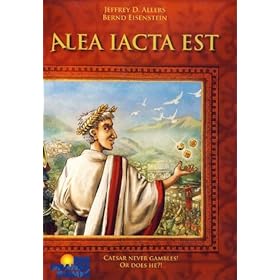
ALEA IACTA EST
Jeffrey D. Allers & Bernd Eisenstein; Alea-2009/Rio Grande-2009; 2-5
Rival noble Romans compete to become the most famous man in Rome
by influence allocation to the army and conquest, to the Senate, to
temples and to earning money (via pay toilets!). The method used is
rolling and placing dice.
[Amazon]
AMBER ROAD
Dam Glimne & Grzegorz Rejchtman; Mindtwister AB-2012; 2-4; 45; 9+
The Amber Road was a trade route from Rome to the sources of
prehistoric amber in the Baltic. Players lead expeditions
along this road, dealing with food and water consumption,
oxen transport, trade and unexpected terrain and new territory
boards are revealed only when needed. The winner is the first
player to arrive.
APPIAN WAY CAFE
Richard Hopkins-Lutz; Chicken Hut Games-2011; 2-6; 8+
Probably the first Roman game delving into the topic of food
service.
In the Imperial period, players represent
waiters who play cards
trying to fill the most orders and earn the most tips.
Players work on three orders at a time. Special event cards
throw wrenches in the works.
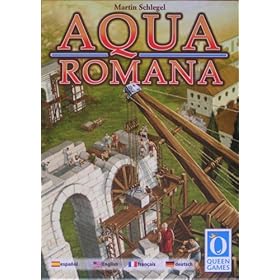
AQUA ROMANA
Martin Schlegel; Queen Games-2005; 2-4; 8+
Players take turns starting, expending and completing elements of
Ancient Rome's water supply, trying especially for length.
[Amazon]
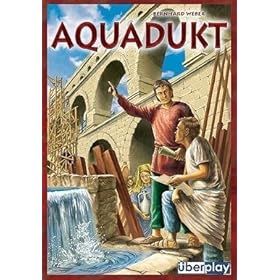
AQUADUKT
Bernhard Weber;
Schmidt-2005/Überplay-2005;
2-4
Players build houses and then start constructing aqueducts to supply
them with water. Houses that by the end have had their aqueducts
diverted and so do not receive water do not count by the end. But
one can't build houses wherever desired either; the roll of a 20-sided
die tells where lots are available. Of course, if one is lucky the
neighborhood already has water! Then too there is the decision of
how large a building to construct.
[Review]
[Amazon]
ARENA – ROMA II
Stefan Feld; Queen-2009; 2
Complete standalone game in the mold of
Roma
which can also be combined with it to make a larger game.
[Amazon]
ASTÉRIX: PAF! LE ROMAIN
Sébastien Dubois; Atomic Mix-2012; 2-4; 20; 4+
Players take the roles of
one of Astérix, Obélix, Bonemine, or Abraracourcix.
Each uses clay to make make three Roman soldiers, which they try to
get (roll-and-move) to the other end of the board before they are
smashed. This happens because each player places his main character on
a space, like a land mine. Should a Roman end on that space, he gets
to smash.
ASTERIX UND DIE RÖMER
Klaus Teuber; Ravensburger-1990; 2-6;
8+
(in French as Astérix et les Romains)
The players are racing to win a bet on who will collect the most Roman helmets.
Dice game.
[Amazon]
ATTILA
Karl-Heinz Schmiel;
Hans-im-Glück-2000
Despite their joint tradition of presenting systems which
adhere closely to their themes, here designer Karl-Heinz
Schmiel and publisher Hans-im-Glück have presented
one in which point of view is somewhat difficult to locate.
Instead in 370 AD one buys "shares" of different tribes such as
Huns, Vandals and Goths and then scores points if first or
second when the scoring round is triggered. Otherwise interesting
however with a significant make-strategy-as-you-go feeling and
quite a few interesting dilemmas. Reminiscent of
Web of Power
and in the tight integration of the subsystems,
Die Macher.
[Review]
AUF CAESARS SPUREN
Jürgen Renner; Melsunger Spiele-1992; 2-6; 30; 8+
"On the track of Caesar" is a trivia/educational game teaching
about ancient Rome. Players roll and move through the empire,
answer questions and collect coins as rewards.
AUGUSTUS
Paolo Mori; Hurrican-2013; 2-6; 30; 8+
Players are governors working for the first emperor, trying to
build up the provinces. This is reflected by satisfying the
demands of objective cards. First to complete seven is
appointed consul and wins. The mechanism is drawing tokens
from a bag.
AVE
Valentin Herman; Fanfor-2000
Features a map of Rome on a square grid on which
are placed buildings, plazas and people. A map of the
Mediterranean shows where players, representing Caesars,
attempt to conquer. The Forum is where votes are taken
to influence these decisions.
Players earn victory points by placing buildings, streets, plazas
and mines in Rome. But in order to do so, the senator with the
right connections must be influenced to do so. At the same time,
Rome is expanding its empire around the Mediterranean through
conquest. This is also achieved through influencing the right
senators. Supposedly much better than its very small and
desktop-published print run would indicate.
[Amazon]
AVE
Tim Lampasona; Vitsika Games-2015; 2-4, 30
Living card game with each player representing a general, senator,
noble or priestess battling for favor in the Emperor's court.
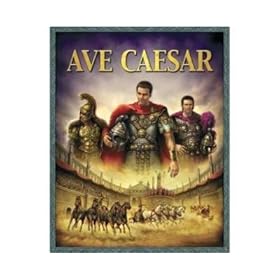
AVE CAESAR
Wolfgang Riedesser; Ravensburger-1989/Pro Ludo-2006
Chariot racing in the Hippodrome. Plays easy and quick, but
depends on players not overindulging in blocking moves to avoid
becoming processional.
[Review]
AVE CESAR
(uncredited); Bureau De Juegos-2013; 4-7; 60
Card game of buying buildings, a little like
San Juan
or
Citadels,
but here set in the Roman period.
In addition to cost and victory point value, card attributes include
military power, political influence and agricultural capability.
AVE ROMA
Szogyi Attila; A-games-forthcoming 2016; 2-5; 45-120
Worker placement game in which workers have a value and all are
common workers. At the beginning of a new turn you always start
with five workers, but depending on your previous decisions you
will always have different workers. Victory comes from creating
buildings, supporting wars, persuading patrons, obtaining influence
in the territories, making money and resources, etc.
BACCHUS' BANQUET
Alex Zucchini; Gryphon Games-2009; 3-5
Players represent satyrs trying to attract like-dressed nymphs to
three bacchanalia.
BACCHUS' BANQUET
Frederic Moyersoen; Mayfair-2008; 2-5
Deduction card game of hidden identities and variable victory
conditions, a bit like the inventor's previous work, Saboteur.
One player is the emperor Caligula, three are conspirators trying
to kill him and the rest are his relatives. Players draft and
pass cards to further their progress toward victory.
BACCHUS' BANQUET: NEW YEARS CELEBRATION
Frederic Moyersoen; Mayfair-2014; 3-5; 30
Expansion for above game adds a New Year's celebration tile.
Takingthis tile means you must accept the next card given to you.
BATTLING GLADIATORS
Ideal-1968; 2-4
Combination of a
Battling Tops system
with a roll-and-move board game.
BAUMEISTER DES COLOSSEUM, DIE
Klaus-Jürgen Wrede; Schmidt Spiele-2016; 2-4; 30
Attractively-illustrated game from the creator of
Carcassonne.
Planning, tile collection and rondel game of competing builders.
BEIM JUPITER
Michael Feldkötter;
Kosmos;
2008; 3-5
"By Jupiter" is a trick=taking card game in which
trump and point values of tricks are determined by all players
before each hand. There are 87 cards in all, including
60 cards ranked 1-14 plus 4 god cards, a Jupiter and a Juno card,
3 sacrificial lamb, 12 number of tricks cards numbered 1-12,
5 marker cards and 5 null trick cards. Played in 8 rounds, it's a
game of declaring the number of tricks you can take to earn points.
Before each hand, players each remove one card and place it face
down. These cards determine not only the trump suit, but also how
many points a trick is worth. (Possibly annoyance: if a player has
only special cards, the entire hand needs to be re-dealt.) If any
suit was chosen more than others, that suit is trump (note that this
means there are fewer of these cards in play than any other suit).
In case of ties, the suit having the high total number of ranks
revealed is trump. If this fails, single highest card decides.
If still tied, it's a no-trump hand. Then each player
uses his card to indicate how many tricks he plans to take and
another card to indicate how much a trick is worth by placing it
next to the cards ranging from 1-12. Only once per game is it
permitted to aim for zero tricks. Normal-trick taking rules apply
with the requirements to follow suit, choice of trump or not if
void, highest card (trump) wins, etc. Jupiter and Juno don't belong
to any suit except for the trump suit and beat any trump. If both
are played in the same trick, the first one down wins it. When god
cards are played, the owner declares whether they are the highest
or lowest in the trick. Even lower are the sacrificial lamb cards,
whose advantage is that they are playable even when one would
otherwise have to follow suit.
BEN HUR
McLoughlin Brothers; 1890; 2-4
Probably invented in response to the
novel Ben-Hur, first published in 1880 by General Lew Wallace.
May be the earliest game ever published on the Ancient Romans.
Includes large game board, four wooden pawns, and two spinners.
BEN HUR
Historien Spielegalerie-1987
Brettspiele
BEN HUR CHARIOT RACE GAME
William Wyler; Acorn
Industries-1957
Players bet to see which chariot will come in first place on the
six-lane, rectangular space track.
BRUNCH AT THE COLISEUM
Michael L. Leeke; Inner City Games-2002; 2-5
Playing the roles of slaves, gladiators or lions, players
have a limited number of actions, e.g. run, eat to recover
strength, pick up items, attack, taunt, throw a limb into
the crowd, beseech the gods or work the crowd for food or
weapons.
BURDIGALA
Bruno Cathala; Id&aL Games-2011; 2-4; 45; 8+
The title is the ancient name for modern Bordeaux and play is
about the development of the ancient city. The board begins
with a number of tiles randomly placed on city buildings.
Players travel about collecting these tiles with special
rewards being given for all participants as each building
completes, but especially for the completer. Moving one's
architects is via dice roll, the goal being to position
oneself so that all rolls will be useful. Special power cards
that break the normal rules can also be earned. Rolling a 7 or
doubles gives the chance to take a corruption card and special
benefit.
[Review]
CAESAR
Jeff Siadek; The Gamesmiths/Prism Games-1993
Players compete to build up legions, gold and aqueducts.
The excitement of their being five different
strategies to try out is not borne out in practice as it is too chaotic.
Rules later revised in re-issue by Prism Games.
[Review]
CARACALLA
Herbert Schützdeller; ASS-1991; 2-6
Players try to find their family members in the
enormous Roman baths complex. Points are given for arranging to
have only certain individuals in the same room; unwanted other
player members hamper that.
CAESAR & CLEOPATRA
Wolfgang Ludtke; Kosmos-1997; 2
Finely-tuned card game.
Many who find two-player situations uninteresting will like this one,
as well as games like Lost Cities and Schotten-Totten,
probably because the inherent randomness of the card deck is in effect
a third player with whom one must contend.
Note for any whose memories may have been blown out by undergraduate
work: memory plays a significant role here.
[Review]
CAESAR'S GLORY
Asger Johansen; Plotmaker Games-2017; 2; 15
Card game of gladiator combat akin to Rock-Paper-Scissors. Each win
causes the opponent to lose a card. Lose all your cards and lose the game.
CALIGULA
Pierluca Zizzi; Post Scriptum/Elfinwerks-2009; 2-5
Card game set in 41 AD.
The emperor has been murdered.
Now it's time to plot to replace him with your own man.
Includes auctions, drafting, negotiations and alliances, 110
cards, 100 tokens and instructions in five languages.
CAPITOL
Alan Moon & Aaron Weissblum; Schmidt-2001
Building houses in Ancient Rome.
[Review]
CARD TAMEN ROME
Kevin Ballestrini; The Game Crafter-2011/The Pericles Group-2011; 2-9
Storytelling card game in which each player gets a deck and
randomly draws seven cards. A Controversy is determined by
roll of a twenty-sided die and then each player gets two
minutes to argue why their card gives the most compelling answer.
The die-roller chooses the winner. Three wins is a victory.
At least partly intended for classroom use.
CHARIOT-RACE AT CARTHAGE CIRCUS
Leila Ladjimi Sebai; alif-1986; 2-4
aka Courses de Chars au Grand Cirque de Carthage
Unsurprisingly, features chariot racing at the Carthage circus.
Movement is via die roll, an odd roll permitting lane change.
Certain special board spaces contain instructions or permit play of
particular cands in hand. Produced in Tunisia for the tourist
market.
CHARIOTS OF ROME
Sean Young; Victory Point Games-forthcoming2018; 2-8; 120
Game of chariot racing for two laps includes the less savory aspects of
this competition.
CHARIOTEER
Stephen Finn;
Doctor Finn's Card Company;
2008; 2-5
Card-drafting and bidding game in which players
recruit charioteers, buy strong horses and chariots, and
try to appease the gods.
CHARIOTEER RACING AT THE FAMOUS CIRCUS MAXIMUS
Ed Teixeira; Two Hour Wargames-2011; 1-4
Another of the many chariot racing games.
Includes both charioteers and patrons betting on the results.
The "track" is just a marker that shows whether you are in a
straight or a turn segment; the real action takes place on a
grid showing chariot order. Drivers are rated for Savvy, Speed and
Strength. Bonus dice which can be used or saved play an
important role in tactics.
CHASING CHARIOTS GAME
Childrens World; (year unknown); 2-4
Game for children in which players move their chariots according to
simultaneously-chosen action cards. Each tries to be first past the
post.
CIRCUS MAXIMUS
Jeffrey Allers; Pegasus-2008; 3-5
This is a card game in which players represent salesmen
in ancient Rome who try to make the most money selling tickets
for various events.
Planned for October 2008. Is to arrive in a tin box.
CLAVIGOLA
Pietro Rubolino, Teodoro Mitidieri & Francesco Sciacqua;
Hasbro-2009
As Caligula's popularity is faltering every day, the players use
commerce, intrigue and manipulation to vault into the imperial
throne.
CLEOPATRAS CABOOSE
Steve Zamborsky; Z-Man Games-2006
A humorous train game set in Ancient Egypt?!
|
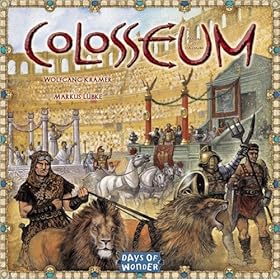
COLOSSEUM
Wolfgang Kramer & Markus Lübke; Days of Wonder-2007
Each player is a Roman impresario, producing great spectacles
in the hopes of attracting the most spectators.
[Amazon]
COMISSATIO ORGY
Julie Prior; Comissatio-1988
Roll a die to move. Buy villas, slaves and chariots and race chariots.
CONCORDIA
Mac Gerdts; Ystari-2013/Rio Grande Games-2013; 2-5; 100
Game of acquisition set on a map of the entire empire, plus some
regions outside it, e.g. Germania. It is also, mildly, a deck-building
game in which players begin with several action cards and can acquire
some similar cards during the course of play. Action cards permit
players to move their land and sea traders. Traders permit
establishment of trade depots in adjacent cities. These may be taxed
CONSULS OF ROME
Jaro Andruszkiewicz & Waldek Gumienny; PHALANX-forthcoming 2016; 2-6; 60-90
Players represent noble families developing their power during the
peak of the Republic. Each player has a deck of cards depicting
family celebrities.
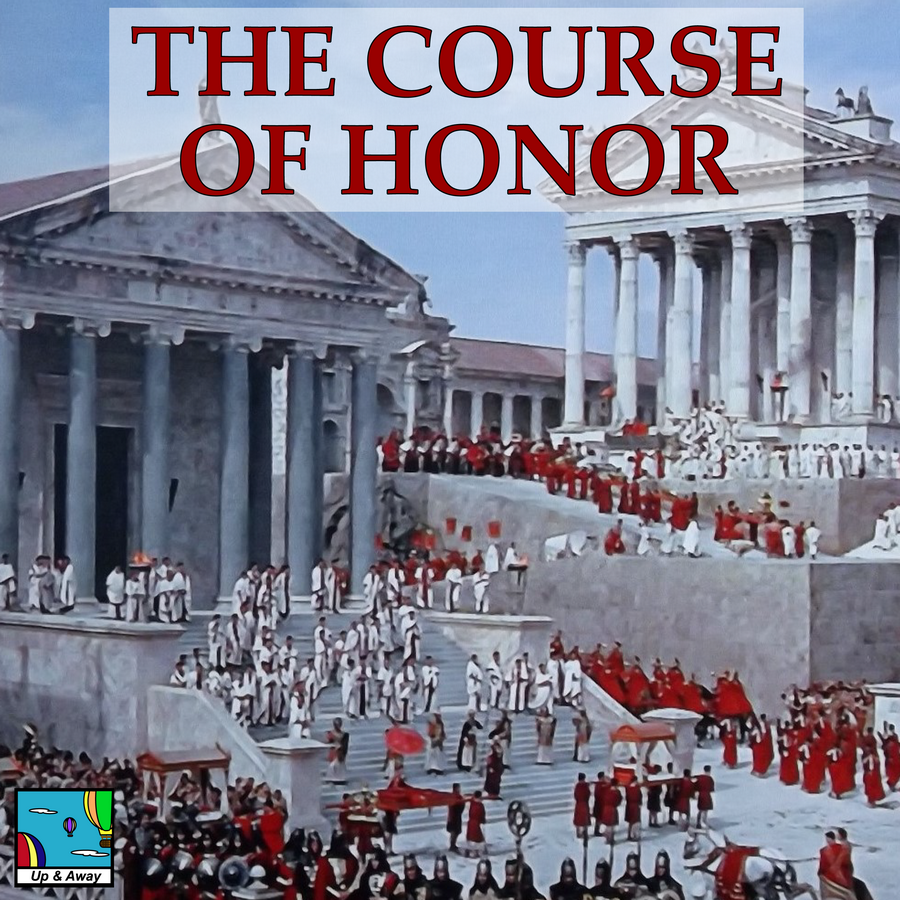
COURSE OF HONOR, THE
Rick Heli;
Up & Away Games-2017;
2-4; 75
|
|
CREDO
Chris Gidlow; Chaosium-1993
Each player represents one of the factions within the
Christian church, each one hoping that their particular
doctrine will be accepted by the religion and thus become
part of the creed.
[Review]: Game Cabinet
DENARII
(unknown); Accent Publications-1984; 2-6; 45
Trivia roll-and-move affair intended to expand knowledge of
the bible. The denarius (plural denarii) was the basic unit
of Roman currency, and what players collect for correct
answers, or lose for wrong ones.
DONNING THE PURPLE
Petter Schanke Olsen; Tompet Games-forthcoming 2018; 2-4; 90
In AD 150 players are powerful Roman families bidding to succeed the
just-murdered emperor. The new emperor must keep the people fed, the
Senators placid and Rome's enemies away. Every player is ready to succeed
you if you fail, but you also need to work together to keep the empire
from falling.
THE DOWNFALL OF POMPEII
Klaus-Jürgen Wrede; Amigo/Mayfair-2004
Players try to make their fortunes and then get out before the
volcano explodes.
Expanded by THE DOWNFALL OF POMPEII: THE DANCING FLAMES.
ERA: ROMAN ERA DECK
Steven Lykowski; (self-Published)-2015; 2-4; 30 minutes
Roman-themed expansion for Era, a "take that!" card game.
FALL, CAESAR
Kelly Wells; The Game Crafter-2014; 5-20; 30
Social deduction game à la Mafia. Twenty characters
are available.
FALL OF THE ROMAN EMPIRE
Martin Wallace; W. Nostheide Verlag-2011; 2-4; 30
Short game of barbarians racing to scoop up the best parts of
the decayed western Roman empire. Players first use chits to chooose
the types of actions – including attack, barbarian attack,
tax – they will take on the round and only then
do all players act. Attacks are resolved by rolls of three
dice. Map shows the entirety of central and western Europe.
FAUSTUS FURIUS
Nicholas Wright; Ganesha Games-2016; 2-8
Two-lap chariot racing using miniatures that can come from any culture or
period, not just Ancient Rome. Players roll 1-3 dice to move. Rolling
higher confers more speed, but overdoing it causes damage. Chariots can
also do things like attack their opponents or incite the crowd.
FORTUNA
Michael Rieneck & Stefan Stadler; The Game Master-2011; 2-4
Worker placement and dice game set in the empire.
Grow wine and grain, irrigate, trade goods, recruit armies,
marry, serve the gods. In the end the player who has done the
most for the empire wins.
FORUM ROMANUM
Wolfgang Kramer; Kosmos-1988
Abstract tile-placing game on a grid.
GLADIATORI
Michele Quondam; Giochix.it/MYBG Co.-2012; 1-4; 90
Players represent customizable gladiators fighting in the arena.
Movement, and also combat, is governed by cards, the deck of
which is also customized. Unusually, dice play no role in
fight resolution.
GLADIATORS
Sam Liberty & Kevin Spak; Rio Grande Games-forthcoming; 2-5; 40
Deck-building card game in which players acquire weapons, armor and
techniques and then using their decks to fight one another.
Non-involved players may bet on the outcome.
GLORIA MUNDI
James Ernest & Mike Selinker; Abacus/Rio Grande-2006
Satirical game in which players are alternately bribing barbarians
not to attack or abandoning Rome as fast as their little legs
will carry them.
[Review]
GLORY TO ROME
Carl Chudyk; Cambridge Games Factory-2005
Card game in which players compete to be best at re-building Rome
following the great fire of the Neronian era.
[Review]
HÄNDLER AUF DEM FORUM ROMANUM
Florian Isensee; Isensee Verlag-2008; 4
"Merchants at the Roman Forum" is a card game of trading
glass,
grain,
wood,
wine and
tin
to purchase better production facilities and ultimately, prestige.
Includes 92 cards.
HANNIBAL
Parker Brothers-1974; 2
Racing game in which players try to get all 12 of their pieces
to the opposite base camp by exact count. This is roll and move,
Similar to Backgammon.
HANNIBAL: THE WAR OF THE KINGS
Kod Kod-1990
A surrounding game played on an 8x8 grid. There appears to be
little connection to the topic apart from the title.
HAVE CHARIOT WILL RACE
John Shaw-2001; 2-8
Chariot racing around an oval track of rectangular spaces.
Movement is in track position order, ties being broken by dice.
Special rules determine how to treat collisions.
THE HIPPODROME
E.O. Clark-1900
Said to sell for $175 or more.

|
HORRIBLE HISTORIES: ROTTEN ROMANS
Mike Siggins & Terry Deary; Sophisticated Games-2008; 2-5
Players represent either Roman slaves attempting to escape a horrible
fate in the arena, which will require bribes, friends, weapons,
tools, etc. or they represent guards attempting to prevent same.
There may be some resemblance to
Escape from Colditz.
[Review]
[Amazon UK]
IMPERÁTOR
Sándor & Zsolt Hajnal; Kerekerdõ Bt.-2007; 2
Collectible card game in Hungarian has players and Roman aristocrats
playing allies and armies, artifacts and events, buildings and battle
fields to be the first to achieve thirty points.
IMPERIUM: FROM REPUBLIC TO EMPIRE
Mike Mollineaux; (web-published)-2016; 3-5; 180
Simplified
THE REPUBLIC OF ROME
meant to require less time.
INTERROGATORY GAME OF ROMAN HISTORY
John Betts; Brunswick-1836; 2
Trivia exercise. May be out of print.
JOURNEYS OF PAUL
Prismatech LLC; 2002
Players represent missionaries traveling through the Roman empire
and starting churches.
JOURNEYS OF ST. PAUL
Eugene Dougherty; Avalon Hill-1968
re-published by
Innovative Game Technologies as Journeys of Paul
Racing game set in the Roman Empire.
JURIS PERJURIOUS
Kevin Everingham; (self-published)-2011; 3-9; 15; 8+
Players are wealthy Romans discussing new laws. Each has a hidden
card representing an influential citizen who supports their claims.
The goal is to be the first player to collect 11 coins and get your
new law approved. Each turn you may trade away your card or use
card powers, the only way to collect coins, look at other player's
cards.
LIMES
Martyn F; ABACUSSPIELE-2014; 1-2; 20; 8+
Card game similar to
Cities
and by the same inventor, but set in the Roman period.
Instead of being concerned with vistas, parks and sightseeing, now
players worry about growing grain, catching fish, choppinng wood and
setting up watchtowers to guard against fire and barbarians.
LUDI AT THE CIRCUS MAXIMUS
Discere, Ltd.-1989; 1-4
Combined chariot racing and word game! The chariots move by roll
of the die. The ending spt gives the prefix of the word the player
must give, without repeating a previously-given word game.
LUDUS ROMANUS
Oxford Games-1996; 2
Place your plastic pieces into a mosaic design, then move them
to capture opponent's pieces.
|
MASSILIA
Alain Epron; Krok Nik Douil Editions-2012; 2-4; 90
Players are merchants in ancient Marseilles, trying to stock
their stalls, gain customers, make sales and use their money
to buy reputation. Employs dice, action points and tile
placement.
MICRO ROME
Michael Bevilacqua; (web-published)-2014; 1; 30
Play cards to your tableau, creating sets to score as many points
as you can while avoiding barbarians before the Colosseum is built.
MINERVA
Hisashi Hayashi; Japon Brand/OKAZU Brand-2015; 1-4; 60-90
Players represent managers sent out by the emperor to develop a
city as best they can. Each player's city is his tableau,
which starts with a single tile and to which he continually adds
drafted tiles. Each tile has a name such as Forest, Foundry,
Circus, etc. and either produces something – wheat, coal,
wood, stone, glory – or has some rules-warping effect, e.g.
letting you destroy a tile. From time to time you place one of your
free, owned tiles which makes all of the tiles in a row from it
produce. Various types of tiles claim victory points. The most
important commodity, and not that easy to get, is money and the
most important buildings, because of the large numbers of points
they can confer, are temples. But temple play can be very Tetris-y.
There is nothing here that remotely feels like developing
a Roman town.
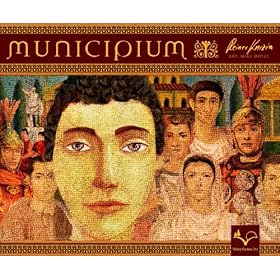
MUNICIPIUM
Reiner Knizia; Valley Games-2008; 3-5
In the 2nd century AD players control powerful families
in a western province. Each tries to place family members as
Scholars, Merchants, Soldiers and Priests. The player with the most
influence in each of these groups exerts power and gains support.
[Amazon]
MURDER IN THE FORUM
Jon Hather; Gothic Green Oak-2015; 2; 30-45 minutes; 8+
Abstract representing a disagreement in the forum of a provincial
town in Roman Britain. Pieces move orthogonally, with the aim being
to trap their enemies while avoiding capture themselves. Capture is
by blocking. A Magistrate and two forum guards have wavering
allegiances, and swap sides each time citizens are murdered. The
two guards can also take part in capture. The winner is the player
to eliminate all the opposing player's pieces.
MURDER MYSTERY PARTY: MURDER IN THE BATHS
(unknown); BV Leisure Ltd-2004; 8
In AD 50 seven players try to figure out who Killed Devius Taxus –
found dead in the plunge pool –
while the eighth attempts to avoid detection.
MURUS GALLICUS
Phil Leduc; (unpublished); 2
Abstract in which players try to penetrate the opponent's wall
on a square grid.
NEUE SPIELE IM ALTEN ROM
Reiner Knizia; Piatnik-1994
English translation called
NEW GAMES IN OLD ROME.
[Review]
NEPTUN
Dirk Henn; Queen Games-2014 3-5; 8+
Players are Roman merchants, delivering goods to cities and temples,
winning by earning the most temple favors. Turns consist of
sailing and fulfilling contracts by delivering goods, but you
must do so in a pre-planned order. Take rewards either in gold
you can use to improve your ship range or in favor.
NEW GAMES IN OLD ROME
Reiner Knizia-1996
English Translation of rules for
NEUE SPIELE IM ALTEN ROM.
Is actually a collection of games:
|
|
100 A.D.
Jim Pinto; SoulJar games-2015; 3-6; 30-90
During the reign of the emperor Trajan, players attempt to control
Roman factions and gain the emperor's favor.
OPTIMATES ET POPULARES
Tom Russell; Hollandspiele-2017; 2; 90
Political game of competing parties trying to win elections and pass the
laws that they prefer, which change the game situation.
Actions cost Political Will, which goes to the opponent, eventually
probably leading to their taking power, at least until they too run out of
Will.
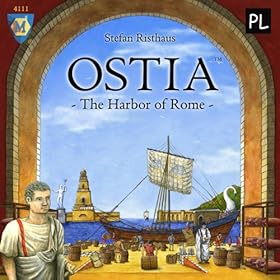
OSTIA
Stefan Risthaus; Pro Ludo/Mayfair-2005; 3-5
Earn money and goods and donate some of them to the Senate.
[Amazon]
PALATINE
Zeke Abuhoff; Greater Gotham-2014; 2-6; 50; 8+
Card game set in the late days of the Republic.
Players represent powerful families competing, via auction,
for money, influence, legions, positions, military commands
and construction of public works.
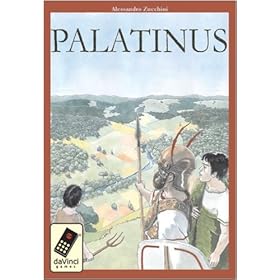
PALATINUS
Alessandro Zucchini; daVinci-2005; 2-5
In 780 BC participate in the original settlement of the seven hills
of Rome. A tile-laying game in which farmers,
merchants and soldiers participate. Depending on their ratios, only
one type controls each hill and score points for the owning
players. A great deal of the information is hidden as except for
soldiers tiles are not revealed until the area is complete and
ready for scoring.
[Amazon]
PALATINUS INSULA TIBERINA
Alessandro Zucchini & Andrés Voicu;
daVinci/Abacus/Mayfair-2006; 2-5
This expansion kit was given away at Essen 2006. It is a new area,
the Tiberian Island, which replaces an area from the original set
drawn at random.
PALMYRA
Bernd Eisenstein; Irongames-2013; 1-5; 45
In the first century AD, Caesar instructs his legates to expand Rome's
influence in this far eastern province by annexing new lands and
farming taxes. The most successful player becomes the new governor.
This tile-layer also includes an army and censor for each player
plus money.
PECUNIA NON OLET
Knut Happel & Christian Fiore; Goldsieber-2005; 2-6
In this card game players represent owners of pay
water closets in ancient Rome, and seek to earn the most money.
Side note: ancient Romans used urine as an agent to get togas their
whitest white. To get the purple stripes, they used a dye made from
rotting snails. One can only imagine what these togas must have
smelled like. Think about that the next time you're watching
Rome.
POLITICO: THE FALL OF CAESAR
John Clowdus; Small Box Games-2010; 3-4
In this card game players represent Senators plotting to
overthrow the emperor. A new potential supporter is revealed
each turn and players choose whether to persuade supporters or
to manipulate the staet of the game. Victory is achieved
either by gaining thirteen supporters or one of each type.
POMPEII
Isaiah Tanenbaum; (unpublished)-2008; 1-6
Tile-laying game; players cooperate to save as many as possible.
POMPEII: DIE LETZTEN TAGE
POMPEII: THE LAST DAYS
Morgantini Simonini; Spiel exklusiv/Another Challenge-1989; 2-8; 8+
Make money and then escape before the lava overwhelms.
[Review]
POMPEII: XV
Whittlecraft; 1-4
Based on conjectures of a game board found at the archaeological site.
POMPEII: WRATH OF VESUVIUS
Jason Little, Dylan Shepherd & Lucas Zerby; Punch-It Entertainment; 2017; 2-5; 45; 8+
Light, tile-laying game of
families vying for control of key districts in the ancient city until
Vesuvio erupts. Players can reveal the reverse of a tile to gain more
influence. During the eruption segment, players actually control the
path of the lava flow, which wipes out tiles. After the flow is complete,
players flip up their surviving unrevealed tiles and score them.
POMPEJI
Frank Brandt; Adlung-Spiele-2001
Light pattern-matching game in which players lay cards so
that they do not match the cards next to them, but
score by matching cards in the same row, column or diagonal.
[Review]
POMPEJI: DIE LETZTEN 37 MINUTEN
Jeff Widderich; CardChess International-2005; 2-4
"The Last 37 Minutes" is a race to escape the lava, earthquakes
and tsunamis before it's too late.
PORTA NIGRA
Michael Kiesling & Wolfgang Kramer; eggertspiele/Gigamic/Pegasus Spiele/Stronghold Games-2015; 2-4; 75-120 minutes
Players are architects working on the "black gate" of the city
Augusta Treverorum (today's Trier). The player architect piece
travels around a circular track, being able to build only in his
current location. Moving is expensive. Cards in your personal
deck tell you the number and types of actions you can take.
Features three-dimensional building pieces.
PRAETOR
Andrei Novac; NSKN Legendary Games-2013; 2-6; 75
Hadrian is building his wall in north Britannia and wants a
new city to support all the builders and soldiers. Players
represent the men assigned to the task; the most successful
one will be appointed praetor. This is a worker-placement game
concerned with workers, resources, morale and recruiting.
PROVINCIA ROMANA
Pierluigi Frumusa; Stratelibri-2014
Card game of Julius Caesar in Gaul.
QUADRIGA
Bernd Lindenberger, Ludger Fischer & Jürgen Franke;
Spielbox-1981; 2-8
Chariot teams race around an eight-lane track made up of hexagons.
Each team covers two spaces. Each team has a current rating for
speed, acceleration and risk of accident. Whipping the horses is
apparently also part of play.
Published in Spielbox magazine.
|
|
QUINQUEREME
Graham Russell; Mindbender Puzzles-2010; 2; 10; 6+
Light game of rolling dice akin to
Yahtzee.
Players compete to get the best results in twelve categories.
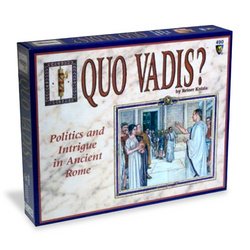
QUO VADIS
Reiner Knizia; Hans im Glück-1992/Mayfair-2000
Negotiation game about machinations within the Roman Senate.
Those familiar with the
cursus honorum (course of honor) actually followed by Roman
magistrates will readily recognize it in the board.
At first glance appears to be a no-holds-barred negotiation outing –
and therefore prone to long delays and boring interludes –
but actually
plays better than it à priori seems. In fact negotiation
is pretty much limited to the first half, after which it shifts
gears into becoming an interesting match in lookahead and outguess.
Features nice plastic pawn figures representing the acanthus.
Title is Latin for "Where are you going?" – probably deriving from the
famous
novel
and
film
of the same name.
[Review]
–
[Review: Game Cabinet]
–
[Review:
Game Cabinet]
–
[Amazon]
REPUBLIC OF ROME, THE
Richard Berthold & Lloyd Haines; Avalon Hill-1990; 1-6
Roman Senate from the first Punic War to the end of the Republic.
An Illuminati-style influence game with a negotiation and shared empire
building game layered on top. Three games in one (with a probable duration
to match). Intrigue in unending complexity with subtleties
probably unrealized by most players. Very historical.
[analysis]
[errata]
[timeline]
[summary]
[war summary]
[variant]
[background]
Review:
Game Cabinet
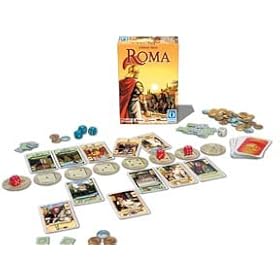
ROMA
Stefan Feld; Queen-2005; 2
Abstract power struggle.
[Review]
[Amazon]
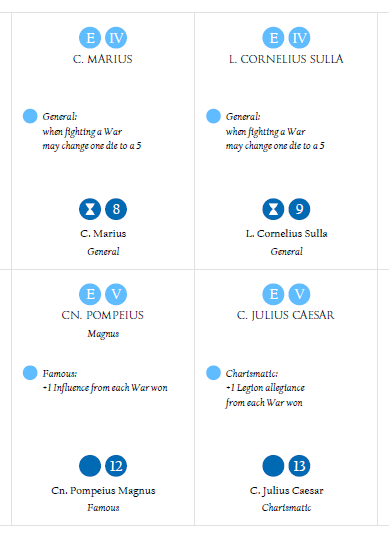
ROMA CELER
Paolo Pellegri; (web-published)-2013; 2-4; 60
 |
ROMAN EMPIRE, THE
Dong-Ryeol Lee; Gamesapiens-2013; 1-41; 8+
Roman-themed card deck with rules for fifty card games.
ROMAN RUINS
Decipher
Party game.
Part of the "How to Host a Murder" series. Characters include
Licentius Caesar, Rotunda Immaculata, Maximus Testosterus,
Cleptopatra, Bogus Fortunatus, Flotilla Submergia, Harangus
Adnauseum, Mercedes Accelleratti.
[Review]
|
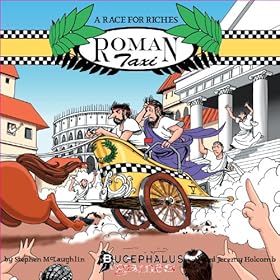
ROMAN TAXI
Jeremy Holcomb, Joseph Huber, Stephen McLaughlin, Dan Tibbles;
Bucephalus Games-2009; 2-5
Pickup and deliver game of driving famous and infamous passengers
around ancient Rome to make the most money.
[Amazon]
ROMANS
Gary Wyatt; Green Board Game Co.-2005; 2-4
Learn history as you travel around the empire conquering forts
in order to be the first proclaimed Caesar.
ROMANS GO HOME
Eric Vogel; Vainglorious Games-2013/Lui-même-2013; 2-4; 15
Card game of Caledonian clans competing to capture
Roman forts along Hadrian's Wall.
Players simultaneously program six warriors against a row of
six randomly-drawn Roman fort cards.
Warrior attributes include strengths and special abilities.
Part of the Celtic Nations Series.
ROME
Reiner Knizia; GMT-2001
Three games from the
NEW GAMES IN OLD ROME
set have been selected for this new offering:
CIRCUS MAXIMUS, HANNIBAL VERSUS ROME and IMPERIUM.
ROME: CITY OF MARBLE
Brett Myers; R&R Games-2015; 2-4; 45-75 minutes
Tile-laying game set in the reign of Octavian. Players compete to
become leading architect. Tile types include civic buildings, temples,
baths, theaters, arenas, bridges, fountains and aqueducts.
ROME: FROM REPUBLIC TO EMPIRE
Jason Keeping; (web-published)-2015; 1; 40-80
Solo game of the Roman state/empire 200 BC-100 AD. Conquer parts of
of Europe, the Middle East and North Africa using cards.
Gather resources via dice and expand in Military, Spiritual,
Production, Commerce, Political and Wonders while trying to avoid
slave and other uprisings. Although the Keeping divides the map
into provinces they do not appear to be the historical ones.
|
|
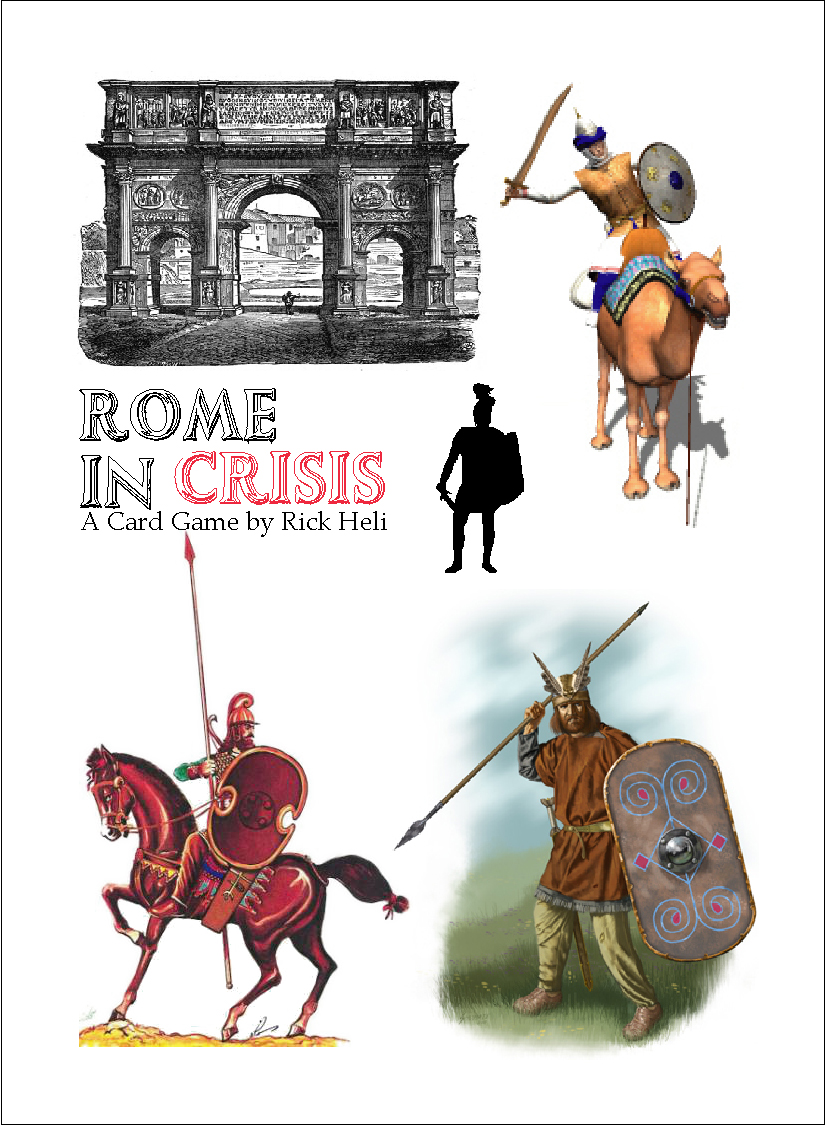
ROME IN CRISIS
Rick Heli;
The Game Crafter-2016;
2-4; 60
A card game of the Ancient Roman Empire in a turbulent
period when Rome was beset by invaders from several sides.
Each player controls a number of imperial candidates whom
they try to push to the top position to gain honor and prestige by
solving some of Rome's many crises before quickly yielding to the next
emperor.
[BGG]
ROME IS BURNING
Lloyd Krassner;
Warp Spawn Games;
2003; 2
Players compete to become emperor.
The circular track has 12 spaces,
two cards being placed on each.
These include
Assassination, Bread & Circuses,
Political Support, Military Support, Intrigue, Soldiers,
Reputation, Private Entertainments, Public Entertainments, Orgies,
Tortures, Arena Games, and Decrees.
After seven turns the player with the highest score wins.
ROME: RISE TO POWER
Elad Goldsteen; Golden Egg Games-2015; 2-4; 60
Becoming the first permanent dictator of the Roman Republic
via dice rolling and card drafting.
ROME: RISE TO POWER – REVOLT!
Elad Goldsteen; Golden Egg Games-forthcoming; 2-4; 60
Mini-expansion for the above game to include about five cards.
RÖMER
Rudolf Ross; Hexagames-1990; 2-4
Trick-taking card game dealing abstractly with Roman horses and wagons.
RÖMISCH POKERN
Johannes Krenner & David Parlett; AMIGO Spiel-2015; 2-6; 30; 8+
Dice game of trying to form the highest possible Roman numerals
from your results. Each player has six action cards that he can
used to convert unfortunate rolls.
ROMOLO O REMO?
Michele Quondam; Giochix.it-2013; 2-4; 90
"Romulus or Remus?" is set at the mythological founding of Rome (the
second founding myth, skipping over the one about Dido and Aeneas).
Players represent competing leaders in the Latin area, trying to
build the strongest city. Critical factors include citizens, which
perform actions (worker placement), and territory (area influence),
since actions can only be performed where the player is in control.
Players also need to ensure that all of their citizens are fed.
Buildings, special characters, soldiers, mercenaries and declarations
of war are also part of the picture.
Expansions thus far include:
RUBICON
Giber I/S-1990
Players roll a die to move towards Rome. Players can make
deals that either force or prevent movement. Players not
in a deal must move. Whenever a player crosses the
Rubicon, he picks up a card that can affect movement,
end the round premature, negate other cards or nullify deals.
RUBICON
The Game Crafter-2010; 3-6
Players represent leaders vying for control of Rome via
influence or military domination. Activities include
elections, courting the people, voting in the Senate and
attacking barbarians.
|
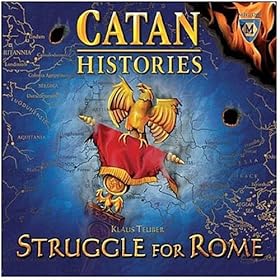
KAMPF UM ROM
STRUGGLE FOR ROME
Klaus Teuber; Kosmos-2006; 3-4
Barbarians take over the late empire, Catan-style, featuring
armies, forts, supply wagons and a map covering the western empire.
[Review]
[Amazon]
SAECULUM
Jana-Madlen Schütte; Kallmeyer Verlag-2008; 1-6
Published at Essen 2008, this historical quiz game has one
player reading a question with its three possible answers and each other
player using ABC cards to simultaneously answer. Then the question
card must be placed in correct historical order in relation to the
other cards.
(A saeculum is a length of time roughly equal to the potential lifetime
of a person or the equivalent of the complete renewal of a human
population, a term first used by the Etruscans. During the reign of
Augustus it was decided that this should be 110 years.)
SENATOR
Eric M. Lang; Fantasy Flight-2004; 3-5
Card game of competing statesmen.
[Amazon]
SENATUS
Jim Pinto; Gray Mass Games-forthcoming 2018; 3-6; 90
During the reign of Trajan, Senators vie for the emperor's favor and
pass bills to improve their statuses and gain influence over factions in
Rome. Employs negotiation, area control and worker placement.
SEVEN HILLS OF ROME
Heo Namchul; Game O'Clock-2009; 3-4
Players represent nobles in the earliest days of Rome's settlement,
trying to bring in as many client settlers as possible and get
yourself elected consul.
SIGNUM MORTIS
Hajo Peters; Saladin Games-2011; 3-6; 240
Based in part on the proscriptions mentioned in
Marcus Tullius Cicero's famous speech in defense of Sextus Roscius.
Players run Roman gangs during Sulla’s reign and try to both
build a reputation for daring, but also proscribe the wealthy and
extort grain merchants and those working in the red
light district. Yet Sulla's minion must be paid, another gang may rob
you or you may run into Sulla's veterans. The goal is to become the
richest and most powerful gang leader.
SPONSIO
József Dorsonczky; Fullcap Games/Ludicus/Mind Fitness Games/PixieGames-2016; 3-4; 45
Trick-taking card game of gladiators and betting on outcomes.
STRADA ROMANA
Walter Obert; Games in Italy-2009/Rio Grande-2009; 2-5
Covers the wagon trade between Rome and its port at Ostia.
Merchants not only try to get "there" first, but also to do
business along the way.
SYLLA
Dominique Ehrhard; Ystari-2008; 3-4
Also known as Sulla, the
Roman dictator, who ahead of Caesar, set the
precedent for marching on Rome.
In a system apparently reminiscent of
REPUBLIC OF ROME
players vie to become "First man in Rome". Shared features are
semi-cooperativity and unfortunate events such as plagues.
Strangely persecution of Christians seems to be a part of it,
which is too early for the period.
TABULA - THE ROMAN GAME
Past Times-1990; 2
Recreation of the ancient Roman version of what is
today better known as Backgammon. In ancient times
it was also sometimes known as Alea. The board and
components do not seem to be trying to be replicate the
ancient game except with respect to the rules.
[Review]
TITUS
Uwe Rosenberg; Adlung-Spiele-2000; 2-4
Card collection game with a memory aspect.
[Review]
TRAJAN
Stefan Feld; Ammonit Spiele-2011/Hutter Trade-2011; 2-4
Players vie in the spheres of political influence, trade and
conquest. Possible turn actions include
build, trade, attack, influence, draft and place tiles.
Takes half an hour per player.
TRIBUN: DIE BRUTIER ERWEITERUNG
TRIBUNE EXPANSION
Karl-Heinz Schmiel; Heidelberger Spieleverlag/Moskito-2008/Fantasy Flight-2009; 3-6
Expansion kit for TRIBUNE (see below) adds the Bruti family
and the possibility of another player.
TRIBUNE: PRIMUS INTER PARES
Karl-Heinz Schmiel;
Heidelberger Spieleverlag/Fantasy Flight Games;
2007; 2-5
Players represent patrician families attempting to gain dominance
over the various factions in Rome. Each round begins with players
allocating their pieces to various board opportunities and then
they are resolved in order, similar to
Pillars of the Earth.
Included are the collection plate which gives cash, many locations
which give cards (the slave market, forum, latrine, senate,
atrium, catacombs, pantheon), the altar to Mars – laurels;
faction track – faction control. Factions are named gladiator,
legate, praetorian, plebeian, patrician, vestal and senator. Many
of these locations require spending either coins or cards to
complete. Victory conditions are printed on cards and so can
differ from playing to playing.
[Review]
TRIUMVIRATE
Travis Worthington; Indie Boards and Cards; forthcoming
2010; 2
Trick taking card game also featuring bluffing, deduction and
drafting. Players represent noble houses during the First
Triumverate period (Crassus, Pompeius and Caesar).
TUCHULCHA
Marco Donadoni; daVinci-2003; 2-4
Not strictly actually set in Roman times, but rather in those of their
predecessors of a sort, the Etruscans.
Players make sacrifices during the 6th century BC.
[Review]
12 CAESARS
Carlo Bertocchini; Game Works-1997
Card game in which players conduct a series of
blind auctions for one of the twelve Caesars named
in Suetonius' famous books of the same name.
Each Caesar has a different point value based on
his chronological order. There are also bonus points
gained for gaining a series. There is no attention
to theme whatever. Cards are rather flimsy.
With blind bidding and luck of the draw, there is
little to no stategy.
[Review]
URBS ROMANA
Lloyd Krassner;
Warp Spawn Games-2009; 2-4
Tile-layer on an 8x8 grid about development of the ancient city.
VIA APPIA
Michael Feldkötter; Queen-2013; 2-4; 8+
Players are road builders in on the famous Appian Way
stretching from Rome to Brindisi in the south.
The goal is to build the most valuable sections and be the one
to connect cities.
Heavy with over 234 components.
VIA ROMANA
Knut Happel & Christian Fiore; Goldsieber-2008; 2-4; 8+
Players are road builders in Ancient Gallia.
Milestones are placed along roads via cardplay, the goal being
to have the most milestones along a section once it is
complete. New cards are received via drafting.
Includes 55 cards, 156 wooden tokens and one legionary eagle.
VILLA RUSTICA
Lloyd Krassner;
Warp Spawn Games-2008; 2-4
In this web-published card game each player represents a senator
competing for gold, influence and prestige.
AUF SPURENSUCHE AM LIMES
Gerhard Junker; self-2012; 2-5; 60
"On the trail of the Roman forts" is an archaeological game in
which players first build the board by stacking up findings
and covering them with "dusts of time" tiles. Then they try to
remember and find them again. Each has an expedition leader
who travels around the board. The goal is to find tiles of
your own color and not accidentally help others too much.
Includes a 48-page background booklet.
HOW TO HOST A MURDER: ROMAN RUINS
Decipher
Party game.
Role-playing and solution of a mystery. Episode 11.
PANTHEON
Bernd Brunnhofer; Hans-im-Glück-2011/Rio Grande-2011; 2-4
Peoples such as the Egyptians, Romans and Germans accumulate
raw materials worship gods in different ways, but
unfortunately the movements of the gods are unpredictable.
Draftable options on a turn include travel,
dancers, farm produce, temples and prayers.
Not very thematic.
Illustrated by Franz Vohwinkel.
[Amazon]
PAX
Bernd Eisenstein; Irongames-2011/Rio Grande-2011; 2-4
During the Spartacan Revolt players are escaped slaves trying
to increase influence and undermine the Rome. Cards affect
progress in seven different categories. By the end playern
need not only to be the strongest, but also stronger than
Rome, or, join forces with Rome and if it is victorious,
become the winner. This card game supports up to eight
players if two copies are owned.
RES PUBLICA
Reiner Knizia; Hexagames-1991/Salagames-1992/Avalanche-1999
Rummy-like trading game which includes Romans
centers around trading and set collection.
The innovative mechanism is that the player wishes to arrange a trade,
but may only state either what he wants or what he wishes to give away,
but not both. This makes for some interesting considerations, but does
not seem to work very well at the top end of the number of players where
things become very static and slow.
[Review]
[Review: Game Cabinet]
REVENGE IN ROME
Edna Hill Maples & Patricia A. Stewart; University Games-1985; 6+
Party game.
Games in the Murder Mystery Party series are a throwback
to the parlor games of medieval Europe. Guests assume their
roles and stay in character throughout the party in an
attempt to solve the murder. All guests are given information
to read privately which reveals their motives and hidden
pasts. A lively cross-examination should ensue. All players
must answer questions truthfully, but are not required to
provide more information than asked. An exception is the
murderer who may lie freely. Accusations are made at the
conclusion of the final chapter, the winner being the player
who guesses the author's solution correctly. The setting
of this particular mystery is Rome in the year 1985 where
an American citizen has been found dead in one of the
catacombs. The roles in the game are the deceased's son,
the son's wife, the wife's parents, the deceased's secretary
and the deceased's lawyer. A 33 and a third phonograph
record is included to provide a sense of atmosphere.
[Review]
VENI VIDI VICI
Horst Alexander Renz; Pharao Brettspiele-2011; 2; 45
A pure abstract move-and-capture game akin to Chess.
The board includes terrain, which enables ambushes, has swamps
to avoid and forts into which retreats may be conducted, but
which may also be besieged.
WANDERING OF THE PEOPLES, THE: THE VOELKERWANDERUNG
(unknown); Decision Games-forthcoming; 60
In 5th century AD barbarian chiefs race to lead their tribes into the city
of Rome. Along the way they must content with Roman legions, the gods
and treachery in their own ranks.
Ancient Roman culture has been a great influence on western culture. Even the modern American classic meatloaf recipe has roots in the Roman Empire. The Roman version from 400 AD actually was made with cooked animal brains rather than the ground beef used in contemporary meatloaf recipes. Follow any modern meatloaf recipe to learn how long to bake a meatloaf by weight.