
|
Want to design
your own dino- saur game? Or interested in lists of games about the Silk Road? Romans? China? Wine? Pirates? Visit "Games About". |
|
| Top Recommendations: | ||||||||||||||||||||||||
|
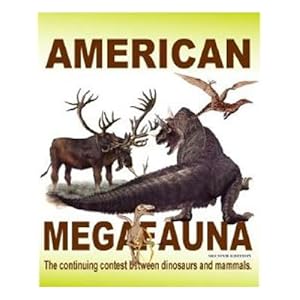
American Megafauna
Buy it at Amazon
Phil Eklund;
Sierra Madre Games-1997;
Sierra Madre Games-2001;
(five-player expansion-2006);
1-5 (introductory game 8+)
The evolutionary contest between dinosaurs and mammals, starting with
the Triassic (when these two megadynasties were on equal footing),
through the Mesozoic (when dinosaurs had the upper hand), and into the
Cenozoic (today's struggle between mammals and birds).
Not a kiddie game (although the introductory game can be played by them)
but a full-fledged, fairly realistic simulation.
[synopsis]
[summary]
[DNA chart]
[analysis]
[errata]
[variants]
[scenarios]
[playback]
[pbem playback]
[pbem playback 2]
[background]
Apex Theropod Deck-Building Game
Apex Theropod Deck-Building Game: Saurophaganax Expansion Deck
Apex Theropod Deck-Building Game: Stomping Grounds Expansion Deck
Bios: Megafauna
Bitin' Off Hedz
Burp
Conquest of Pangea
Conquest of Pangea: Atlantis
Cretacea: The Game of Gargantuan Survival
Dino
Dino Bash
Dino Drache
Dino Dunk
Dino-Duell
DinoGenics
Dinoland
Dinomania
Dinos, Dice and Dynamite
Die Dinos sind los
Dinorennen
The Dinosaur Game: Survival or Extinction
Dinosaur King
Dinosaur Wars
Dinosaurs of Catan
Dominant Species
Dragon War: Jurassic Valley Set
Evo
Evolution
The Evolution Game
Evolution Earth: Cataclysm
Evolution in the Box
Explorers of the Lost Valley
Extinction
Fossil Hunters
Giganten
Great Dinosaur Hunt
Great Dinosaur Rush
In a World of Dinosaurs
Mesozoic Tales
Pangaea: The Evolution Game
Pirates vs. Dinosaurs
Prehistoric War P.I.G.s
Reptile Island
Die Schlacht der Dinosaurier
Sir Harry and the Dinosaurs
T-Rex
Tetrazoic
Trias
Herschel Hoffmeyer; Die-Hard Games LLC-2015; 1-8; 45
Deck-building game in which each player represents one of
nine prehistoric apex predators competing for territory
and resources against other predators.
Each species has a unique 35-card deck with different strengths, weaknesses,
and strategies. Challenges include
climate changes, disease, attacks from predators,
infections, and deadly prey. There are many types of dinosaurs that
behave in their own ways. The goal is to
build up the population, evolve and become the Apex predator.
Herschel Hoffmeyer; Die-Hard Games LLC-2016; 1-8; 45
Expansion kit for the Apex Theropod Deck-Building Game (above)
includes 70 Cards and a card divider. Card types:
New cards permit pulling cards from the discard pile.
Herschel Hoffmeyer; Die-Hard Games LLC-2016; 1-8; 45
Expansion kit for the Apex Theropod Deck-Building Game (above)
includes 70 Cards and a card divider. Card types:
Emphasis is on greater direct interaction.
Philip Eklund;
Sierra Madre Games-2011;
1-5
The third version of American Megafauna
features considerable streamlining and simplification.
Cheapass Games-1996; 2-6
A simple race game that lets you use your own plastic dinosaurs for
pieces. Dinosaurs can throw rocks at each other to
knock
the other guy
back to Start, and they can accomplish the same thing by "Bitin' Off Hedz"
(landing on the other fellow's square). You win by being the first
to get to the volcano and
throw yourself in!
Play is usually short, but can become interminable if too many
players get on board.
Harald Bilz, Peter Gudbrod, Rainer Kröhn; Heidelberger
Spieleverlag-1992/Mayfair; 2-4
Players represent a stone age village struggling to
climb the evolutionary ladder
by discovering inventions.
Philip Orbanes; Winning Moves (USA)-2006; 2-4
Species advance, evolve and battle on the super-continent which
re-shapes itself during play. Apparently there is a great deal of
randomness...
Philip Orbanes (?) for Winning Moves (USA)-2006; 2-4
An expansion kit for the above game, it adds Atlantis as an additional
continent plus a few other additions, as well as clarifying the rules to
the main game.
Arthur Hannan; (unpublished)-2016; 2; 60
Rules for miniature combat intended for 1/100 scale.
Reinhold Wittig; Hexagames-1989/Fun Connection-1992; 2-6
The board is a 6x6 grid, on which a jungle
valley is shown.
Each player runs a science team,
travelling to the past t: steal dinosaur eggs.
Each player gets 2 play figures, then 6 nests are allocated to
different playing fields with 5 dinosaurs to guard them. A meteorite
is placed on a track which runs around the board.
On his turn, a player may move a piece up to
four fields. Unused points are used to advance the meteorite.
Players must walk around squares containing dinosaurs.
If it reaches an egg space, he may take it. The more eggs obtained,
the greater the number of points. But take care to return to the present
before the meteorite strikes, which ends the game. Positive points
are awarded for eggs, negative ones for researchers still in the past.
Originally published Edition Perlhuhn as Iridium in 1988.
Nigel Gross & Jon Sutherland; Symbiosis Publishing Ltd-1993; 3; 60
In a bar in an imagined world in which dinosaurs never died out, each player
represents one of carnivores, herbivores or mammals.
Each character features
Wounds Points, Action Points, Combat Points, attack style and special
abilities. They may employ various items in the bar to aid in the
fight.
Virginia Charves; Ravensburger-1993; 4
No other information available.
Cody Stevens; Twin City Games-2018; 2; 45
Dexterity game of dinosaur basketball using wooden disks.
On a turn players flick either a dino or the ball to move, pass or shoot.
Jonathan Schouten and Paul Velleman; Ducosimo-1992; 2; 30
Each player begins with four dinosaurs in each of three types on the.
back rows of a 6x7 board.
A turn is moving horizontally, vertically or diagonally.
Capture is possible only under very special arrangements of pieces
on the board. Players seek to get four pieces adjacent to the
central river.
Richard Keene; (unpublished); 3-5; 120
Worker placement game of players competing to build and run dinosaur parks.
They assign agents to compete over resources and then build
facilities, populating them with dinosaurs. The best dinosaurs bring
the most visitors, but if you haven't spent enough on the facilities
they can escape and destroy parts of the park.
Andrea Angiolino, Fabrizio Casa, Luca Giuliano, Massimo
Casa, Stefano Giusti and Marco Bardella; Clementoni-1993;
2-4
Each player leads an expedition to save dinosaurs, eggs, fossils and babies
from a volcano-threatened island. Play is determined by a videotape with
Professor Darmin on your screen as if it was at the spaceship window.
The trick is that the professor's description matches the spaceship's current
location so getting close to it will ensure success.
(unknown); (web-published)-2016; 2-5; 30
Dinosaur-themed card game of being the first to clear your hand (i.e. a shedding
game).
Andrew Hagen; (web-published)-2014; 1; 45
Press-your-luck and worker placement solitaire game of paleontogists
in the Old West. You have a crew of workers to help discover new types
of dinosaurs and defend them from others. Includes a deck of cards,
six dice and a programmed opponent.
Wolfgang Riedesser; ASS-1993; 2-4
The cards show different dinosaurs and the board a jungle
as well as nests with colored eggs (nest tiles).
Each player gets nest tiles in his colour as well as the suitable
dinosaur. All figures start at the volcano. The remaining nest
tiles are shuffled and dealt
to the individual nests on the playing field so that
that nobody can see where the broken eggs are. Each player is dealt
three cards.
On his turn, each player plays a card and then moves his piece.
Cards alow movement of the dinosaur or the players.
The idea is to collect good eggs from nests and avoid empty nests
and broken eggs.
In English, the title is The Dinosaurs Are Loose.
Friedemann Friese & Ilja Landsberg; unpublished (1992); 3-5; 45
Prototype in which each player has a racing dinosaur that moves and
also fights via card play.
Latz Chance Games-1995; 2-16
The board shows a long, serpentine track over which players move their
pawns, propelled by die rolls. Each one represents a different type of
dinosaur. Some spaces grant food tokens while others are perilous,
e.g. natural disasters. In addition, it's possible, via cards, to be
attacked by other dinosaurs. The winner reaches the final space while
still having enough food remaining.
Sega/Upper Deck-2005; 2
Collectible card game set in the Cretaceous era based on the
television series for children of the same name. The set of over 150
cards include Spinosaurus, Triceratops and, of course, T-Rex, which
the players send into battle employing simple rules. The cards also
include barcodes so that players can scan them into their game
consoles. Cards include background information, strength, type,
element, technique and critical hit type.
(unknown); The Game Crafter-2015; 2-4; 150
Players represent fossil hunters in the Badlands during the late 1800's.
They set up by choosing crew and equipment and then try to find bones
in complete sets and return them to a museum for money to use for
further expeditions. Rustlers, claim jumpers and calamities ar
challenges to overcome. Employs a modular board and roll-and-move.
Rick Heli; PnP-2001; 3-4
A variant for the popular game Die Siedler von Catan / The Settlers of Catan
[rules]
Chad Jensen; GMT-2010; 2-6
Worker placement and
area control game beginning 90,000 BC just as an ice age begins.
The possible powers are mammal, reptile, bird, amphibian, arachnid and insect.
Lasts about 3 hours.
Robert A. Kraus; RAK Graphics-1999; 2-6; 45
Dinosaur-themed expansion to the Dragon War fantasy game.
Ron Shirtz; Fractal Dimensions-1998; 1
Solitaire game of World War 2 marines battling a variety
of dinosaurs and other megafauna such as sabertooths on a
Pacific Island.
Kevin Wilson; IDW Games/Pandasaurus Games-2016; 1-6; 60
Cooperative game in which players are stranded time travelers who must
reassemble their ship before the eruption of a nearby volcano. Other
challenges are roaming dinosaurs, time rifts to close and historical
figures to round up. Each player has unique abilities.
Philippe Keyaerts; Eurogames/Descartes-2001; 3-5
Your aim is to develop a new species of dinosaur including features such as
weather, land (3 levels from sea level (warmer) to high mountains (colder),
other players' dinosaurs, movement points, attacks and an auction system
allows you to buy new genes (horn, fur, leg, etc.) in order to evolve your
dinosaurs.
The prototype was the winner of the Sim D'Or 99.
[Review: Haag]
David Wells; Ariel/Fantasy Games Unlimited-1976; 2
This is played in rounds divided into three phases:
Growth, Movement and Attack. Players begin by placing one piece on any
intersection. Then in Growth, new pieces are placed for the existing
ones, but not adjacent to any other pieces. The maximum size of a group
is five pieces. After all growth is complete, Movement begins. Only
groups of two or more pieces may move and moving has several other rules.
Following this are Attacks. Each piece bordering an opposing piece may
attack, calculating its strength from its neighboring pieces of the same
color. The weaker piece is removed. Only one piece may attack in a round.
At the end, for each occupied intersection a player receives one point.
Also known as Guerilla.
Simon Boswell & Phillip Lewis (Finland)-1997; 2-4
Simulates competition for territory with other species, changing
environmental conditions, plagues, starvation, natural disasters, global
catastrophes, mutation, ecological niches and the geological sequence
from the Precambrian to the Pleistocene on an abstract board.
Tomi Rantala & Jaana Hintsanen; Mindwarrior-2009/Tactic-2009; 2-4
Deck-building card game in which players build the continents of the
world and then try to conquer them with their evolving species.
Jirí Mikolá; Jirasgames-2009; 2-5
Players begin play representing a forerunner of modern man, trying to
find meat and evolve his brain, which helps hunting skills. Command
cards are used to decide where the player's tribe will move and
whether they will be able to hunt any mammoths.
Enrique Dueñas González; Gen-X Games-2016; 2-4; 25
Press-your-luck dice and
card game of African explorers who discover live dinosaurs and try to
capture as many as possible.
On a turn reveal two dinosaur cards. Try to capture one by rolling
dice higher than their difficulty.
Gary Sinauer; Sinauer Associates-1968?/1970/1971/Carolina Biological Supply Company-1978
An educational product. There were rules for several games, but only
the main one seems to have any interest. Players represent a species
on an island and have genes, reproductive rate, prey attack and
defense, habitat, mobility, etc. Players can change their "genes"
during play, with players eliminated by competition, being preyed
upon, or over-population. The 1978 edition changed the reproductive
attribute cards from a fixed litter size to a multiple of the number
of creatures in an area.
[more]
Kevin Lanzing; Clockwork Colossus Games/The Game Crafter-2015; 2-5; 30
Area encirclement game. Players use wooden sticks to divide the board
and establish their claims. They then try to finish their claims
before time runs out.
unknown; Carlit-1992; 2
Differently-equipped dinosaurs battle on a checkerboard
à la Chess or Stratego.
Ronald Keippel; self-1993; 2-4
Trivia game said to last thirty minutes.
Scott Almes; APE Games-2015; 2-5; 60
Game of collecting sets of fossils. Each turn has two phases:
dig and build (assemble the fossils into a complete dinosaur). Players may
engage in take-that actions to gain Notoriety, but if at the end they
have the most Notoriety, they lose points.
Pete Betcher; (self-published)-(forthcoming)2015; 2-4; 45
In this two board game reminiscent of
Khronos,
players move dinosaurs as they try to stay alive amid meteors,
landslides, tar pits, hungers, etc. When they die their fossils appear
on the second, modern board, where players try to excavate them in a
a set collection sub-game.
Tito Aureliano;
The Game Crafter-2013/Colecionadores de Ossos-2013; 2-6; 90
Players try to restore order after
dinosaurs escape from a zoo on a remote island.
Directed by mission cards,
they must fight to survive and reactivate the power grid, all the time
limited to carrying at most three items at a time, which can include
vehicles, guns, medical packs and so on.
Or they may play a dinosaur. Which applies depends on a die roll each
at the start of each turn. If a dinosaur, it may be an herbivore or a
carnivore. Dinosaurs are used to hamper the activities of the fellow
players.
Pyramid Games (UK)-1986; 2-6
The game object is to evolve from a lungfish into modern man.
A set of event cards allow moving predators,
evolving predators, and shifting continents.
Somewhat high on the luck factor.
A little like
American Megafauna
stripped very far down.
Also known as Evolution.
Richard Launius; Jolly Roger Games-2010; 2-5; 90
Players control pirate ships whose crews have partial knowledge of a treasure buried on some Pacific island which just happens to be filled with leftover dinosaurs, and also is sinking. At the start players get to outfit their ships with crew, weapons and other equipment. One of their tasks will be to find other pieces of their maps so that they can definitively locate the treasure. Hostile dinosaurs appear in the form of cards played by others. The treasure is dug up by pulling pieces from a bag; deciding how long to keep doing this before getting back to the ship in safety is a matter of pushing one's luck.
[Pirate Games]
Chris Clark;
Inner City Game Designs-2005; 2
A P.I.G. is a plastic infantry guy and this is a miniatures war game of
plastic dinosaurs and cave men (why do some think they are co-evals?) fight.
Brett Christensen; web-published-2010; 1-5
Cooperative game of Victorian-era explorers trying to escape an
island inhabited by two dimetrodons.
Roger Ford; Schmidt-1993
Battling dinosaur armies.
Roger Webb; SFSFW-2003; 1-
A set of miniatures rules for dinosaur hunting in the year 1878 where
dinosaurs are living in the jungles of India.
The player tries to capture as many dinosaurs as possible in a fixed
amount of time.
First published in the magazine Ragnarok, issue 39.
Hanno & Wilfried Kuhn;
Hans im Glück-1999/
Rio
Grande Games-1999; 3-5
The theme sounds just like that of
Dino:
each player runs a science team, travelling to the past to steal dinosaur eggs,
taking care to return to the present before meteorites strike the earth, which ends the game.
On each turn, the players choose to play
high cards to collect eggs or low cards to be able to direct future
collecting efforts.
The winner will be the
player who collects the most points in dinosaur eggs in the 12
rounds of the game.
A mix of trick-taking, card counting and bluff.
Teel McClanahan, III; Modern Evil Press-2014; 2-6; 60
Deck-building game of post-nuclear war genetically-engineered monsters
Cards are monster parts that players use create mutations.
Ralf Lehmkuhl; Gecko Games-2002;
Triassic Terror
Peter Hawes;
Eagle Games-2012;
2-6; 120
Players establish and grow herds, which migrate across the four
environments, competing for the best habitats. Beware dangers such as
t-Rex, velociraptors, pterodactyls and volcanoes.
Triassic Terror: Promo Pack
Peter Hawes; Eagle Games-2013; 2-6; 90
Adds two predator tiles and a pterodactyl (to use as the first player
token).
Tyranno Ex
Karl-Heinz Schmiel; Moskito-1990/Avalon Hill; 2-4
A memory-based game of somewhat abstract evolution.
[Review: Game Cabinet]
Tyrannasaurus Wrecks
Glen Frank; Fantasy Games Unlimited-1985; 2-4
Folio game about time travellers hunting dinosaurs and trying to avoid
getting chomped. Includes two cardstock pages of reference tables,
cardstock hunter record sheet and dinosaur record sheet, 17" by
11" cardstock hex map (the actual playable area of the map is 9.5"
by 10"; the rest of the map contains a turn track and reference
charts/tables), and 141 cut apart counters.
Uchronia
Supposed to be forthcoming in June.
Urland
Urland Expansion
Velociraptor
Some game enthusiasts may want to plan a special chili and board game
night. Participants could each bring a different type of chili, from
the most common
Chuck's chili recipes
to unique
Dinosaur BBQ
chili recipes.
Carl Chydyk; IELLO-2011; 3-5
Card management game set in an alternate universe where dinosaurs and
major civilizations exist side by side. Players vie to construct 7 buildings
and gain influence and reputation points.
Frank Nestel;
Doris & Frank-2001; 3-5
A successor to
Primordial Soup
in theme only, probably one of the greatest successes from Essen 2001.
Perhaps in response to complaints that every Primordial Soup
turn was more or less the same, now
one has at least three or four different types of turns.
There is the turn in which one chooses the island of competition,
after that the turn one spends only planning, after that the turn
in which one goes last and has a very good chance of knowing what the
land of competition will be and finally the neutral turn.
As in the predecessor there are still gene cards which permit players
to "break" the normal rules, but now the game is one of regional dominance
rather than of feeding. In addition, in deciding to breed more fish (which
will later walk onto land), one usually helps other players as well as oneself.
There seem to be curiously few gene cards, but there
is already precedent for an expansion kit. What many players may not realize
and what designers will most admire is just how clean all the rules have been
kept, how just by details like the clever ordering of the phases, the handling
of the scoring track, etc., many extra and niggly rules, e.g. what to do
about ties, have been very neatly avoided. Recommended for all strategists.
Frank Nestel;
Doris & Frank-2003;
3-5
Adds 10 new gene cards.
J. R. Blackwell, Major Johnson, Bri Lance, Daniel Solis, Jesse Whitworth & Andrew Wilson; Board Raptor Games-2012; 3-6; 60
In this card game players represent young velociraptors
that seek prey, mutate and try to survive the environment.
It is also possible to cannibalistically attack opponents.
Learn About Dinosaurs
Spotlight on Games > Ludographies