Spotlight on Games
>
1001 Nights of Military Gaming
- M -
- Magic Realm
Multi-player fantasy war game with a strong role-playing
element. In the 1970s the fantasy role-playing game led by TSR's
Dungeons and Dragons
became the rage in serious gaming. Traditional war game companies
like SPI and Avalon Hill saw significant segments of their customers
shifting to these games. At first a reality they tried to ignore,
eventually they had to do something. Not before 1979, did Avalon Hill
respond with this and, in the same year,
Wizards Quest.
But while these games were created with fantasy settings, they
did not depart much from the heavyweight rules and systems style
of their war games. The inventor's games before this were
historical war games like
Fortress Europa, Victory at Sea and
Victory in the Pacific
(themselves derived from earlier work by John Edwards at Jedko).
Although in this game Avalon Hill found artwork for
the characters and actually credited the artists, they
failed to fully consider or embrace the artistic possibilities
that a fantasy game can offer.
Players each take one of sixteen pre-made
characters (of the usual types, e.g. White Knight, Black Knight,
Magician, Elf, etc.) and wander about a board composed
of twenty randomly-set tiles which contain monsters and treasures.
Other components are spells, armor, weapons, horses and
treasures. Characters differ a lot in their abilities and
some, such as the Woods Girl, cannot really do well unless
teamed up with another character.
On the plus side, the rules make up for the usual RPG need
to have a gamemaster;
on the minus side, these rules are rather involved. There are now
three versions, the first two suffering from having been
written in the programmed learning format, which is nearly impossible
to use as a reference. This is especially pernicious here as an
80-page rule book needs a lot of referencing. But even with a
traditional format, the game is rendered difficult to play by
the addition of so many tables and complications meant to completely
model all that could occur in its world.
The value in all these rules is unfortunately only in their
thoroughness; originality and cleverness did not really come into it.
Combat, for example, sees the character placing in one location and
then just rolling a die to see whehter the monster(s) match up in
an advantageous position or not. If they miss one another this can
go on for several stultifying rounds; a simple die roll would work
just as well. The sudden appearances of monsters are just as random;
at one moment you can be looking for treasure and in the next a fast
monster lands on you and you're dead. Speaking of this,
searching for treasure is another very random activity. A player
rolls two dice needing a 1 and a 4, but only the higher number counts,
so finding something takes quite a long time. Overall a playing can
easily require ten hours or more. This could be re-designed with
more modern practices that eliminate the waiting and easily take a third
off the time. The communication design is not done well either. For
example, the Inn starts on a random tile, which is determined by
random placement of a chit. But strangely this chit does not say Inn,
but says some other words, e.g. "Dank Valley", which much then be
looked up in rules. In fact there is so much looking up of rules
and tables that this game should really be played with an electronic
tablet nearby.
Yes, there is a great deal of welcome fantasy flavor here, but it's
really far too slow, and long, and number-heavy for most who would
otherwise be interested. Complete list of characters, which no
doubt influenced later efforts like
Talisman:
Amazon, Berserker, Black Knight, Captain, Druid, Dwarf, Elf,
Magician, Pilgrim, Sorcerer, Swordsman, White Knight, Witch,
Witch King, Wizard, Woods Girl.
Players interested in this sort of thing are well-advised to try
the more modern and accessible
Return of the Heroes.
See also What makes magic realm intriguing.
Strategy: Medium; Theme: High; Tactics: Medium; Evaluation:
Low; Personal Rating: 5
Richard Hamblen; Avalon Hill-1979; 1-16
- Magic:
the Gathering
The famous collectible card fantasy game revitalized gaming in
America during the late 1990's. Frequently-changing rules and
all of the inevitable problems attending collectibility are just
two reasons not to get involved.
- Maharaja
War game in the Britannia
system, this time set in India from the Aryans to the British.
The system is quite similar to its predecessor apart from the
addition of factories in later stages of the game. That, and the
submission rules have gone quite wild as Britain will probably
own, directly or indirectly, nearly every area on the map. It's
questionable whether it was wise to extend to post-industrial
times a system originally intended to model early tribes. Has a
lot of problems, including not much activity for the player of
the yellow tokens, possibly because
the designer died during development. Read more about it in
this extensive variant.
[background]
- Make You Gunfighters
In this card game from Japan players begin with a group of five
gunfighters whose present locations are indicated by the five cards
held in hand. On a turn one of these can move to one of the other six
locations by discarding the card and drawing a new one. Or he can take
a shot at another player's gang by simply showing a card for a location
or one that's adjacent, as indicated on a small map. Any gunfighter
card the target player has at that location is lost and the shooter
earns money if any such card contains one or more dollar icons. With
money a player has a third turn option, to "advance the story" by
turning over an event card. Some of these help, some hurt –
losing two turns isn't much fun – and some affect all players.
There are three ways to win, but two of them – set collection or
money collection – seem rarely practical. Rather all playings seem
to end by means of elimination. However, a player who gets down to just
one card gets to pull a Climax card which probably has a special ability
prolonging his survival. Despite the amusingly fractured English of the
title, the instructions are clear and unambiguous. The cards seem to be
laminated, but only on one side. The board is a flimsy affair and the
cardboard coin tokens really should be replaced with something nicer.
If it hasn't been noticed already, this is
Go Fish
with the addition of six shooters. But with its very short turns and
amusing flavor, even an elimination game like this can be effective.
Of course, control of any sort is frequently absent and there's
nothing particularly innovative either. And yet when played in the
right spirit – perhaps after midnight – it does offer a
certain manic energy that is appealing. And how many closers do you
have that tolerate seven players?
Strategy: Medium; Theme: High; Tactics: Medium; Evaluation: Low; Personal Rating: 5
Kondou Koushi; Bouken; 2007; 2-7
- Mare Nostrum
Military game set in the ancient worlds of Egypt, Babylon,
Athens, Rome and Carthage. Each turn is played out in
three acts. In Trade, players receive commodity and tax
cards corresponding to their caravans and cities. They
then have a joint group trade using a system that
can be considered a refinement of that employed by
Andromeda
– drafting one card at a time from one another, rather than
an entire group of cards. In Construction, they turn in these
groups of cards in unique sets of 3, 6, 9 or 12 to create new,
for example, caravans, markets, legions, fleets, fortresses,
heroes, wonders – the latter two confer extra abilities.
A set of 12 unique cards or enough of the 9 card sets wins the
game, and immediately. At most two tax cards may be saved.
Finally, in War players move their legions and fleets and
conduct combat. Armies use fleets to hop over seas à la
Diplomacy. Each combatant
rolls a die and total pips are divided by five. Every resulting
point, rounding down, scores an enemy loss. Since the average
roll is only 3.5, only one round of combat is allowed and
fortresses always roll sixes, legions are relatively feeble.
Sea combat is allowed, but optional. In total, the situation
reminds of Material World
– play without combat is certainly viable and will
yield a runaway winner in 60-90 minutes. The only realistic
way for the rest to prevent the leading player achieving
this is combat, thus generating an additional hour of contest.
History fans will find the theme a hit-and-miss affair. As in Magellan,
there is a wide space of time between suggested coevals Julius
Caesar (died 44 BC) and Hammurabi who lived at least 2000
years earlier. An opportunity has been missed since actually
Rome, Carthage, Egypt, the Greeks and the Seleucan Empire all
did more or less co-exist as powers. National advantages like
that of the Romans to produce legions more easily make sense,
but others, such as ignoring the Carthaginian naval ability
less so. It's as if the ultimate Carthaginian defeat at sea is
all that matters and the Phoenician mastery of the waves over
six previous centuries can be tossed off like a passing wave.
In fact, everywhere the perspective seems to concentrate
on the popular view of history rather than the actual. It's
similar with the map coverage which totally ignores Hispania,
a very significant mining region. Who could suspect that a title
referring to all of the Mediterranean would only depict a portion
of it. The artistic presentation does better. A brown and bronze
map suggests something the ancient planners might use in their
war rooms. Round counters are large enough to show attractive
illustrations and avoid the problems previously encountered in
Clippers.
Apart from one error, the player aid sheets are comprehensive
and attractive at the same time, although many will want to
laminate them. The trading cards are very attractive, although
numbers might have helped when trying to figure out how many
uniques one has (sorting alphabetically seems almost as good).
Who wins after this multivariate war depends on manipulation,
foresight, positioning and good dice rolling. The latter
point tends to fit ill with the master strategists who would
otherwise be attracted. Another limitation seems to be a lack
of strategic options. It appears that for each side there is a
single best economic path and not much variation either in the
military path. There are five different sides to play, but once
those are exhausted it's not clear they will bear repetition.
There are also relatively few decisions to make – many will
prefer that significant choices with a wide number of options come
more frequently. Contrast this with other recent opuses of this
type. In Wallenstein
the starting position is very different every time and
offers the fun of programming simultaneous orders. In Empires of the Ancient
World, there are several different starting options
as well as strategic options, e.g. sea, engineer, trader,
etc. It also offers the additional challenge of programming the
combat deck. Another issue the intended audience may have is
that of balance. With the advanced (free) setup, there appears
to be a pronounced advantage for the Greeks who can postpone
their leader and concentrate on an all taxation policy and the
Romans who will certainly not start with a fortress when it can
be purchased more cheaply later. But a side like Carthage tends
not to do anything much different from the basic setup and so
hardly benefits at all. Thus the basic setup is much preferred,
but even then a side like Carthage seems to have a tough time
doing well, despite being the usual Commerce director. After five
playings, it seems that with experienced players it will often
be the case that several players are set to win at the same
time and that victory is not really a matter of true domination,
but of just happening to edge first over the line (important to
be the Political leader), a victory rather out of sync with the
military theme. It's a very fragile system, depending as it does
on everyone's willingness to play good defense against a leader
and others not taking advantage of those defenders for their own
gain. It's also rather demanding in an accounting sense of the
Commerce leader and traders not to accidentally give an opponent
too good a trade result. Such accounting may not be to the taste
of many players. Really this is an analyst's dream, not so much
on how to win, but on how it should be played to stop leaders and
ensure a level playing field. While this appeals to a certain
segment of the playing population – notably those interested
in design issues – at the end of the day the intended audience
will finish with this game frustrated. Ironically in a military
game, the best feature of all is the trading system. Mike Siggins
once made a comment about Andromeda that also applies:
"is alternately VERY interesting, and then almost pointless".
Even though true, a fun game should be possible with a
further developed form of this subsystem at its center.
[analysis]
- Masquerade
This is a card game in a fantasy/manga setting invented by the
maker of
Fairy Tale
and
Saga,
both of which are part of an ever-increasing and impressive
development from multiple creators in the Japanese game
industry (cf.
Traders of Carthage,
R-Eco,
Mermaid Rain
and
Make You Gunfighters).
This one features several ideas that are not really new, but
are well-combined and judiciously balanced together. Each
player has a secret identity card – shown as a different
mask – with a unique supplemental victory condition.
Each also drafts a different special ability before play.
Then each round players take turns drafting turn order cards
– not the same one two turns in a row –
which also each confer a special ability. In this order, then,
they choose which of several locations to visit, each
providing a different function and each limiting the number of
visitors. The library gives a spell, the circle two spells at
the cost of a health, the tower a chance to fight the current
monster, the arena a chance to fight another player, etc.
Combat is fairly deterministic with the attacker adding spell
cards to his basic power rating and the defender having the
chance to respond (monsters adding a drawn spell card). There
are also three "emblem" cards which like the
Catan
longest road award is held by the player who has accomplished
the most in a given category. There are also mechanisms to discourage
a runaway leader. In fact the only real downsides are that
the slim spell deck, which will probably be gone through at
least three times, features some spells which are rather
better than others, e.g. the one that permits winning any
combat, or the one that permits stealing it. The players lucky
enough to acquire these should do well. The other issue is
that play seems to go on too long – ninety minutes perhaps
– for a game with such a
limited number of choices. This might have an easy fix,
however, by simply removing at random a couple of monsters
from the deck. The artwork is not bad and the cards well made.
Four is probably the optimal number of players.
Strategy: Low; Theme: High; Tactics: High; Evaluation: Low; Personal Rating: 7
Satoshi Nakamura;
Yuhodo Inc./Z-Man Games;
2003; 3-5
- Material World
Multi-player war game on a world scale uses area movement and
simple mechanics. A fresh take on the traditional war game instead
presents the classic "guns vs. butter" dilemma since in order
to win players must expand trade routes and invest in consumer
goods in order to accumulate victory points. At the same time
it is possible though hardly efficient to invest in military
technology and to build armies. Incredibly powerful, this forces
the same activity on the part of the other players. Thus the
typical game sees the player furthest behind building up and
devastating his neighbors who thereafter must do the same to
their neighbors (if any of the wherewithal to do so remains) or
see them coast to victory. Alternatively, the players all begin
the game defending every trade route with armies and the game
lengthens from three hours to six. Contains an astonishing 840
counters, the majority of which will not be used, but not many
games can boast counters depicting Leonardo da Vinci, Einstein,
Martin Luther and others. Rules are straightforward, exceptions
and political realities being kept to an absolute minimum,
but some rules are not found where one expects. Overall,
the concept is admirable and the board mechanics are nice
and clean, but needed quite a bit more development to deserve
attention as something more than a political-economic statement.
Later retrofitted with new rules by the original designer
untried. [chart]
[analysis]
[notes] [Pirate Games]
- Medici [International Team]
Somewhat abstract Renaissance period war game.
[more]
Games of the Italian Renaissance]
- Melee
War game about warriors battling one another in an arena.
The combat half of Wizard is a clean combat system that
works well, although a bit limited after multiple playings. Later
expanded in Advanced Melee, one of the components of the
RPG The Fantasy Trip. Features attractive artwork by
Liz Danforth.
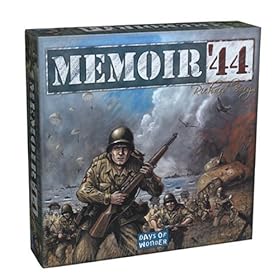
- Memoir '44
Light, two-player game of second world war western front
operations. Designed by Richard Borg along the lines of his
Battle Cry (1999) also includes a plethora of plastic pieces.
Battles are tactical, representing small snippets of a front. A
unit's ability to take losses is handled by placing multiple pieces
in its hex space, but curiously losses do not affect firepower,
which is determined via special dice. Perhaps combat losses are
more meant to represent losses to morale. The best and worst of the
game are the same feature: the randomly drawn cards which determine
which of one's units may move and fire each turn. Normally a card
permits only one flank or the center to operate. Thus it can be
difficult deciding just what to do each turn. Planning for
eventualities and shifting forces between fronts can be challenging
too. Can you manage to win despite limited conditions? On the other
hand, sometimes the cards can be so skewed to one's advantage,
or disadvantage, that all the fun falls out. It's surprising that
there are no rules, e.g. card drafting, to cope with such
situations. It's surprising too that in this high quality package
there are so many rules contradictions and special case issues,
requiring the use of downloaded FAQs and which engender unwelcome
dead time. This, combined with what is probably just one too many
levels of detail, prevents it from being a suitable gift for
younger players or any who are not hardened gamers. Overall this
was a nice idea, but neither developer nor publisher have
delivered as well as they might have. It would also be nice if the
cover artist could explain why the paratroopers are landing
in the ocean.
Strategy: Medium; Theme: High; Tactics: High; Evaluation: Low; Personal Rating: 6
Richard Borg; Days of Wonder-2004; 2
[Buy it at Amazon]
- Middle-Earth: Gondor
Two-player war game from the
Lord of the Rings novel by J.R.R. Tolkien depicts
the battle and siege of capital Minas Tirith in which Gondor
tries to stave off the forces of the Dark Power. Much of the map
depicts the seven levels of the city, but most of the fighting
occurs outside it. There are special rules for climbing walls,
pouring oil on climbers, catapults, catapulting captured heads
to demoralize the city, etc. Initially the Dark Power is the
attacker while the Westernesse side has fun once reinforcements
arrive. There is not much room for strategy as there is usually
only one obvious way to do things and games seem to follow a
regular pattern. Other complaints are that more terrain might
have been included outside the city, the rules for magic feel
tacked on, there is no character interaction, no test of wills
between Gandalf and the Witch King and no special minor character
presence (Legolas and Gimli). Throughout, the emphasis is on
what the underlying military situation might have been rather
than on really trying to mirror the literary feeling. There are
some errors too. The Harad Axemen counters read B3Y while the
rules say E2Y. One of the Mordor light archers says e1Y while
all of the others and the rules say e1Z. It is not clear when
oil can be used: is it only during
the Sauron movement phase? Also, what happens when attack levels
are reduced by one, yet a unit (an E or an e) is already at the
lowest level? If there is an effect, what about anti-personnel
catapults? If a Gondor unit is in a Tower and a Sauron unit
is on the other side of an unbreached gate, may the Gondor
unit attack? Do the Mumakil count as cavalry? Do combat units
use siege towers during the Siege phase or the Combat phase?
Is it allowed to catapult an undisrupted unit (for purposes of
controlling a level)?
There are also ambiguities around re-moralizing the garrison (more DP?).
Strategically, most of the proactive challenge is on the
Sauron side, who should try to lower the enemy attack ratings and then
block the Rohirrim with Mumakil. Use the Fear spell to nullify the AP of catapults.
Above all, never lose a leader.
- Middle-Earth: Sauron
Two-player SPI war game from the works of fantasy novelist
J.R.R. Tolkien depicting the Battle of Dagorlad between Sauron and
the Last Alliance of Elves and Men at the end of the Second Age,
SR 3434. A rather flavorless rendering using the cookie-cutter
SPI medieval system, plus the Beast of Mordor, never mentioned in
the books at all. The subsequent full revelation of the Tolkien
universe in books such as
The Silmarillion
or even just Robert Foster's excellent
The Complete Guide to Middle-Earth
in which the Beast clearly has no place makes it looks a rather
unfortunate choice in retrospect.
Most of the same complaints on the above Gondor apply here as well.
I have
created an extensive variant to
address at least some of the issues.
[analysis]
- Middle-Earth: War of the Ring
War game based on the
Lord of the Rings
novel by J.R.R Tolkien and centerpiece of the Middle-Earth
game set which also included the games Gondor and
Sauron. Versions include a
character- and monster-only game and another which adds in all of
the armies. A three-player rule allows Saruman. The map
of Middle-Earth is very nicely done as is the card art,
although flimsy. Play of the game has some interest and
strategy, but most games seem to end in the same way, with
a Fellowship party at Mount Doom fighting all of the Dark
Power characters, i.e. not very satisfying from the point of
view of the novel. Combat is a rather abstract, one-on-one
affair. The army game is similar except that a lot of time
is wasted managing incredibly huge armies which really have
no final effect on play in any case. One strange artifact of the
combat system is that the smaller the army size, the less it loses in
combat. This permits the Westernesse player to dot the landscape with
tiny delaying forces that will ultimately stop the Dark Power in its tracks.
Another problem is that the logic of a novel does not
translate well into a game. For example,
for most of the novel the Dark Power had no idea where
the ringbearer was, but in the game it is usually fairly
obvious and the player can easily send forces to the right
place to search. Consider also that the Dark
Power player knows that his opponent is trying to bring
the ring to Mount Doom in order to destroy it, but in the
novel that entire strategy was never even dreamed. It is
difficult to reflect that level of stupidity in a meaningful game.
- Middle Sea
Subtitled "Empires of the Feudal Age", the
multi-player war game set in the thirteenth century includes rules for economics,
warfare and diplomacy.
Area map includes Mediterranean lands from Bay of Biscay to the Red Sea, from the Black
Sea to Morocco.
During Winter turns players deal with revenue, maintenance
and levies. During the other seasons, there is movement and combat.
As in
Diplomacy,
orders are written and both armies
(leaders, infantry and cavalry) and fleets (galleys and round ships) are
included. There are also coastal raids and fortifications.
Combat damages not only armies, but also revenue capacity.
Cards denote the owner of each area, which vary in their revenue-producing
capacities.
The game setup is not historical. Instead each player has free choice
of three starting provinces and hopes to expand outward.
There are also rules for spies (which permit examination of the face down
units in a province) and blockades.
Map and counters have attractive, authentic heraldic shields.
Obscure due to very small print run, an interesting if longish effort
that deserves more attention than it has.
Probably best for 5-7 players.
[Fantasy Games Unlimited]
- Mighty Fortress, A
Six-player war game set during the Christian Reformation, the
antagonists being the Lutherans, Papacy, German (Holy Roman)
Empire, Ottoman Empire, France and England. Played on a hex map,
each player uses one set of four unknown overlapping victory
conditions. There are a lot of interesting features here and
plenty of room for negotiation. The Papacy and Lutherans are
different from other positions in being more concerned with
converts than territory. The ping-pong match between the Papacy
and England over Henry VIII's divorce can be considered "iron
maiden" rules as there is never any reason for the players not
to perform historically — it would have been much better if the
penalties for their actions were expressed not in victory points
but in actual play effects. Serious rules ambiguities will make
you want the errata from the web; even then be prepared to come
up with house rules from time to time. Tends to be too long
for what is going on. With
Russian Civil War,
in SPI's "Power Politics Series" and
one of only two outside designs SPI ever published, the other being
Winter War (not described here).
[summary]
[analysis]
[playback]
- Mind Duel
Magazine game about psychic combat in a science fiction setting does not
seem to work at all as printed. It is not difficult for players to run
into a situation where they cannot move at all and be easily defeated.
- Mission Command Land
Game of modern tank and helicopter combat for children. Combatants
are "the tan" and "the green", the battlefield a square grid. Each
of a player's six tanks has a secret identity number from 1 to 6,
which also provides its number of starting "life points". Also
available to each player are a helicopter, several artillery
pieces and 3 headquarters installations. Movement is restricted
by an overall number of points given each turn. Combat is
conducted via special hit dice similar to those previously
seen in Hasbro's Battle Cry. But just before attacking,
each player must undergo artillery and missile strikes which the
opponent has programmed on a hidden peg board prior to movement.
Since no occupied space can be programmed, a player can avoid
some of this by continually bringing reserve units into the old
spaces. So there are some tactics to the game, but this system
programming has too little impact to justify the time spent
configuring it, even if it is a good idea for keeping the one
involved while the opponent decides moves. There are mildly
strategic things players can do in their setup and positioning
to try to mutually support units, but all seems to eventually
falter under the vagaries of just a few dice rolls. Probably to
avoid too-defensive play, the overall goal is destruction of
enemy tanks, not the installations, so the latter tend to play
an unfortunately small role. The pieces are attractive enough
to be usable as playing figures apart from the board game and
this clarifies the only possible audience: children 8 and above
who would enjoy a little more structure to go with their play
figures. Note that while 8 year olds can certainly play this, most
will need help to learn the rules the first time, and probably
also to complete the considerable assembly required. Otherwise,
there is nothing new here and it's unfortunate that the topic
of multi-unit combat, perhaps the area of most possibility,
is virtually undiscussed in the instructions. It's too bad too
that no packaging is provided to store the 32 plastic pieces
and 60 or so cardboard damage counters, especially since some,
such as the helicopter blades, are rather fragile. Said to be
inspired by Milton Bradley's 1975 Tank Battle.
- Modern Naval Battles
Card game about Cold War naval actions is the Naval War
concept gussied up and gone high tech. Although it looks
nicer, pretty much the same comments apply. This game features
a surprisingly high number of expansions.
[Take That! Card Games]
- Mystic Wood
Multi-player fantasy war game
inspired by
Ariosto's
Orlando Furioso
and Spenser's
The Faerie Queen.
The "board" is composed of a number of
randomly-distributed
inverted tiles which the players must "discover" as they traverse
with the goal of fufilling a quest according to their own personal idiom.
The play of the game is thus very different each time with a high
experience factor, but highly subject to luck. In addition,
there is very little decisionmaking, but with a high potential for boredom
as a player may lose a large number of turns during the game.
This game seems to have begun life as Sorcerer's Cave by
Ariel/Philmar, been revised and re-published under this title by Gibson's
and then again by Avalon Hill.
- Mythology
War game of Homeric Greek heroes who fight monsters and recover
fabulous prizes for up to eight. Each represents a named god or goddess with
special powers who à la
The Sigma File
or
Kremlin
bid for secret control of the twenty-four named and variously
strong heroes as well as the many different monsters. Players may
also spend points to secretly aid or "ail" these counters. Combat
is resolved by rolling a pair of dice to get an 11-66 result
which is added to the attacker's offensive strength trying to
exceed the opponent's defense strength. Players also hold cards
which can perform special effects or give extra value for specific
prizes. There are many problems. Reiner Knizia likes to use the
term "stable" to refer to a game which does not misbehave or go
awry in any circumstances. Unfortunately the term cannot apply
here as things can go quite crazily off kilter. Matters are so
chaotic that almost anything could happen. In fact it's even
possible for players bent on destruction to use the much stronger
monsters to kill all of the heroes. It could also happen that a
player's secret victory bonus could range from unlucky "score
points every time a player causes a tempest" (rather unlikely
if Poseidon happens not be be in play) to the possibly very
lucky "score points for every unclaimed prize". Sometimes the
secret bonus is even in contradiction to one's special powers
although having it depend on what others decide to do seems
quite deleterious enough. Other problems are race conditions
caused by various actions such as Divine Occurrences which the
instructions state can occur "at any time", but leave ambiguous
whether they can interrupt the current action or must wait
until the action is completed. There are communications design
problems too as the heroes have both names and numbers, but are
not listed on the notes sheet in any particular order, either
by power or alphabet. Nor do the numbers appear on the cards.
The sheet doesn't list their strength ratings either. So you
won't be surprised that the seven different ways to earn victory
points are also not listed there. In a reversal of usual war game
convention and for no discernible reason, the defense number is
listed on the left and the attack on the right. With all of the
note taking and testing of control, completing the suggested
number of game turns will take a very long time – probably
eight hours with six players – and each player added
makes it dramatically worse. Even the theme, the strongest
feature here, does not work very well. Usually the gods did
not secretly contest for control of various heroes, but simply
supported their favorites, so one of the main mechanisms feels
entirely foreign. This leads to further oddities such as a
player getting a point just for successfully being able to move
a hero – and losing one if not. It's really too bad that
so many features don't work because the (paper) world map as
the ancient Greeks imagined it looks quite nice and the named
and variously rated heroes, monsters and prizes are very fun,
most of them being already in our heads from childhood readings
of mythology. While this may be re-usable for someone running
an RPG in a mythological setting, it cannot be recommended for
serious play without considerable adaptation.
On to N
- Main
Please forward any comments and additions for this site to
Rick Heli.